

In a year when stock markets around the world, including India, have swung sharply with every statement from the U.S. Federal Reserve or election development, one category has quietly gained investor attention : Arbitrage Mutual Fund India.
What is An Arbitrage Mutual Fund
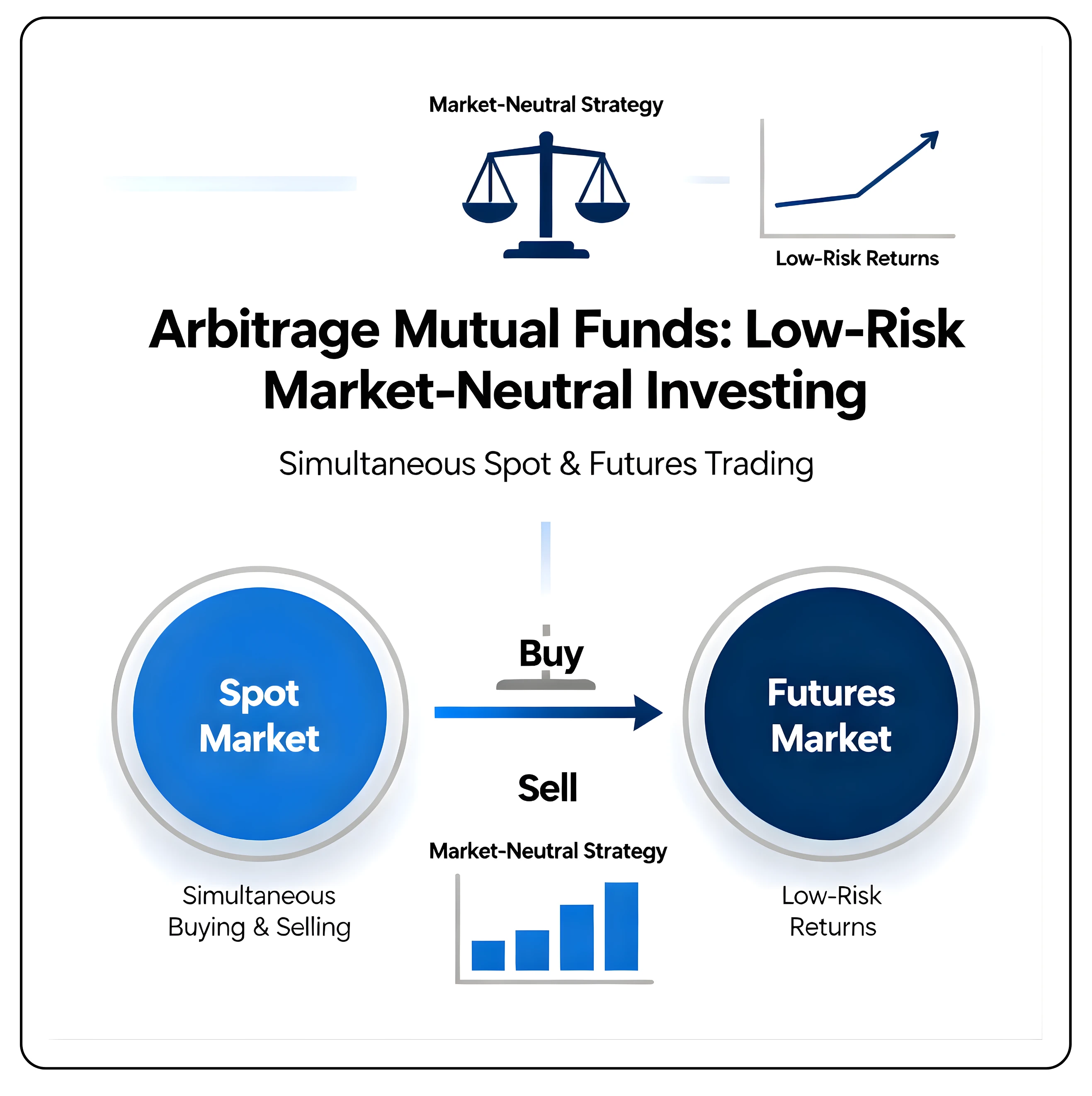
An arbitrage mutual fund is a type of hybrid fund that aims to earn steady, low-risk returns by taking advantage of small price differences for the same stock in two markets the cash (spot) market and the futures market. When a price gap appears, the fund buys the stock at the lower price in one market and simultaneously sells it at the higher price in the other, locking in a small but certain profit. This forms the basis of the cash vs futures arbitrage strategy.
Because these buy-and-sell positions offset each other, the fund isn’t exposed to market direction, meaning it can make money whether the market moves up or down. By repeating such trades across multiple stocks, arbitrage funds convert these small, temporary inefficiencies into consistent portfolio returns, making them a popular choice during periods of heightened market volatility and an attractive option among low-risk equity fund India categories.
How Does It Work?
Let’s say Infosys shares are priced at ₹1,466 in the cash market and ₹1,472 in the futures market. This ₹6 gap between the two markets creates an arbitrage opportunity.
An arbitrage fund manager would buy Infosys shares in the cash market at ₹1,466 and sell the same quantity in the futures market at ₹1,472 both transactions happening almost simultaneously. This locks in a potential profit of ₹6 per share.
When the futures contract expires, both the cash and futures prices align. The fund squares off its positions and pockets the ₹6 difference as profit. What’s important is that this gain doesn’t depend on whether the market as a whole goes up or down—it simply comes from that temporary price gap between the two markets.
How Arbitrage Mutual Funds Earn Returns
To see how arbitrage mutual funds earn returns, let’s take the same example using Infosys shares.
Suppose the fund buys 100 shares of Infosys in the cash market at ₹1,466 each and simultaneously sells 100 shares in the futures market at ₹1,472.
Profit calculation:
Profit = (Selling price in futures − Buying price in spot) × Number of shares
Profit = (₹1,472 − ₹1,466) × 100 = ₹600
So, the fund locks in a ₹6 per share spread, giving a total arbitrage profit of ₹600. Because both the buy and sell trades happen at the same time, the market’s ups and downs don’t really matter, the profit is already locked in. Fund managers repeat this process across many stocks, capturing small differences again and again. Over time, these small gains add up to steady, low-risk returns, which is why arbitrage fund returns volatility tends to stay low even when markets fluctuate sharply.
Also read our blog on Total Expenses Ratio
Why Is It Popular?
Arbitrage funds are appealing to investors who prefer stable, low-risk returns, especially when markets are volatile. Since they invest mainly in equities and derivatives but maintain hedged positions, they are categorized as equity-oriented hybrid funds and benefit from the arbitrage fund taxation advantages of equity funds.
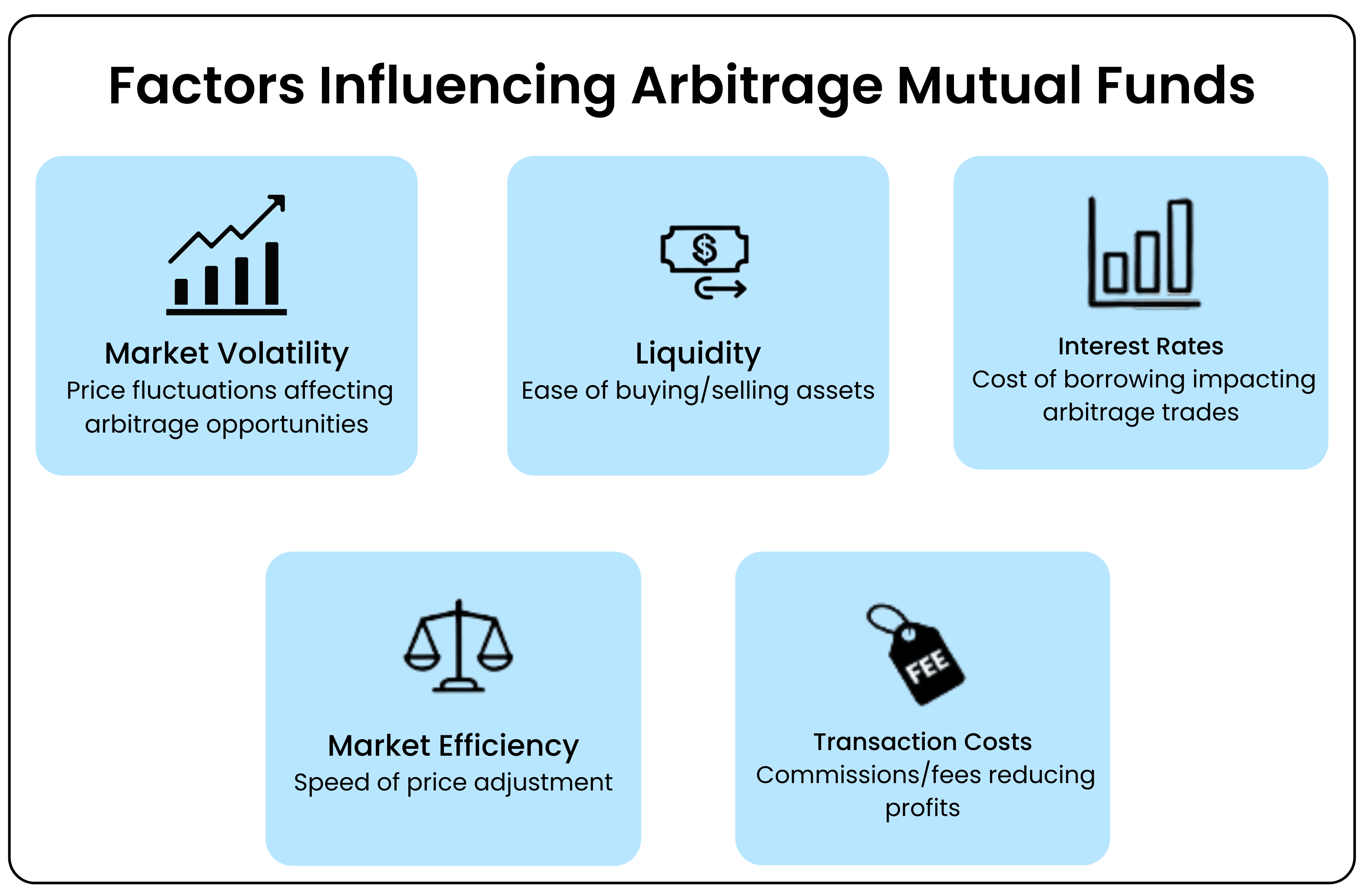
Factors Influencing Arbitrage Mutual Funds
Market Volatility
When markets swing sharply, price differences between the cash (spot) market and the futures market tend to widen. This creates more room for arbitrage mutual funds to lock in risk-free profits. For instance, if a stock’s price jumps in the cash market but doesn’t adjust as quickly in the futures market, the fund can buy in one market and sell in the other. In calmer markets, these gaps are smaller, so opportunities shrink.
Liquidity in Markets
Liquidity refers to how easily securities can be bought or sold without moving their prices too much. Arbitrage strategies rely on executing trades quickly in both markets cash and futures at nearly the same time. When liquidity is high, these trades happen smoothly with minimal slippage. Low liquidity, on the other hand, can lead to delays or unfavorable prices, hurting returns.
Interest Rates
The relationship between short-term interest rates and futures prices plays a big role in determining arbitrage spreads. Futures prices usually reflect the cost of carrying the stock till expiry, which includes financing costs and dividends. When interest rates rise, the cost of carry increases, often widening the spread between the cash and futures prices. That gives arbitrage funds more room to profit. When rates fall, the spread narrows.
Market Efficiency
In highly efficient markets, prices adjust almost instantly to new information. That means any mismatch between cash and futures prices gets corrected within seconds. As a result, arbitrage opportunities don’t last long and are often too small to exploit profitably. Less efficient markets, on the other hand, tend to leave small gaps for a bit longer, giving funds more time to act.
Transaction Costs
Even though arbitrage aims for risk-free profit, those gains can vanish once costs are factored in. Brokerage fees, securities transaction tax (STT), and fund management charges all eat into margins. Since arbitrage returns are usually modest, keeping costs low is crucial for the strategy to remain worthwhile.
Arbitrage Fund vs Debt Fund
While arbitrage mutual funds and debt funds both attract conservative investors, they differ in key aspects. Arbitrage funds invest primarily in equities using the cash vs futures arbitrage strategy, offering low-risk equity exposure with tax efficiency. In contrast, debt funds invest in fixed-income securities like bonds and are taxed at an investor’s slab rate if held short-term. During periods of high market volatility, arbitrage funds can often deliver better post-tax returns, while debt funds perform more predictably in stable interest-rate environments.
Arbitrage Fund vs Equity Mutual Fund
| Feature | Arbitrage Fund | Equity Mutual Fund |
|---|---|---|
| Primary Objective | Generate profits by exploiting price differences between cash and futures markets | Seek long-term capital appreciation through investing in equity stocks |
| Risk Level | Low risk as buy and sell positions are hedged, minimizing exposure to market volatility | Higher risk due to full exposure to market fluctuations and equity risk |
| Suitability | Perfect for conservative investors looking for steady, low-risk returns with moderate growth | Ideal for aggressive investors seeking high growth over a long horizon |
| Tax Treatment | Taxed like equity funds: short-term gains taxed at 15%, long-term gains (over 12 months) taxed at 10% above exemption limit ₹1.25 lakh | Same equity taxation applying to dividends and capital gains |
| Return Profile | Typically delivers stable and consistent returns by exploiting small market inefficiencies | Returns can be volatile, dependent on market performance |
| Investment Horizon | Suitable for short to medium term (3–12 months) | Best suited for long-term investment (5 years or more) |
| Liquidity | Open-ended, reasonably liquid but may attract exit load if redeemed early | Usually open-ended, liquidity varies based on fund type and market conditions |
Also Read: How to choose best mutual funds
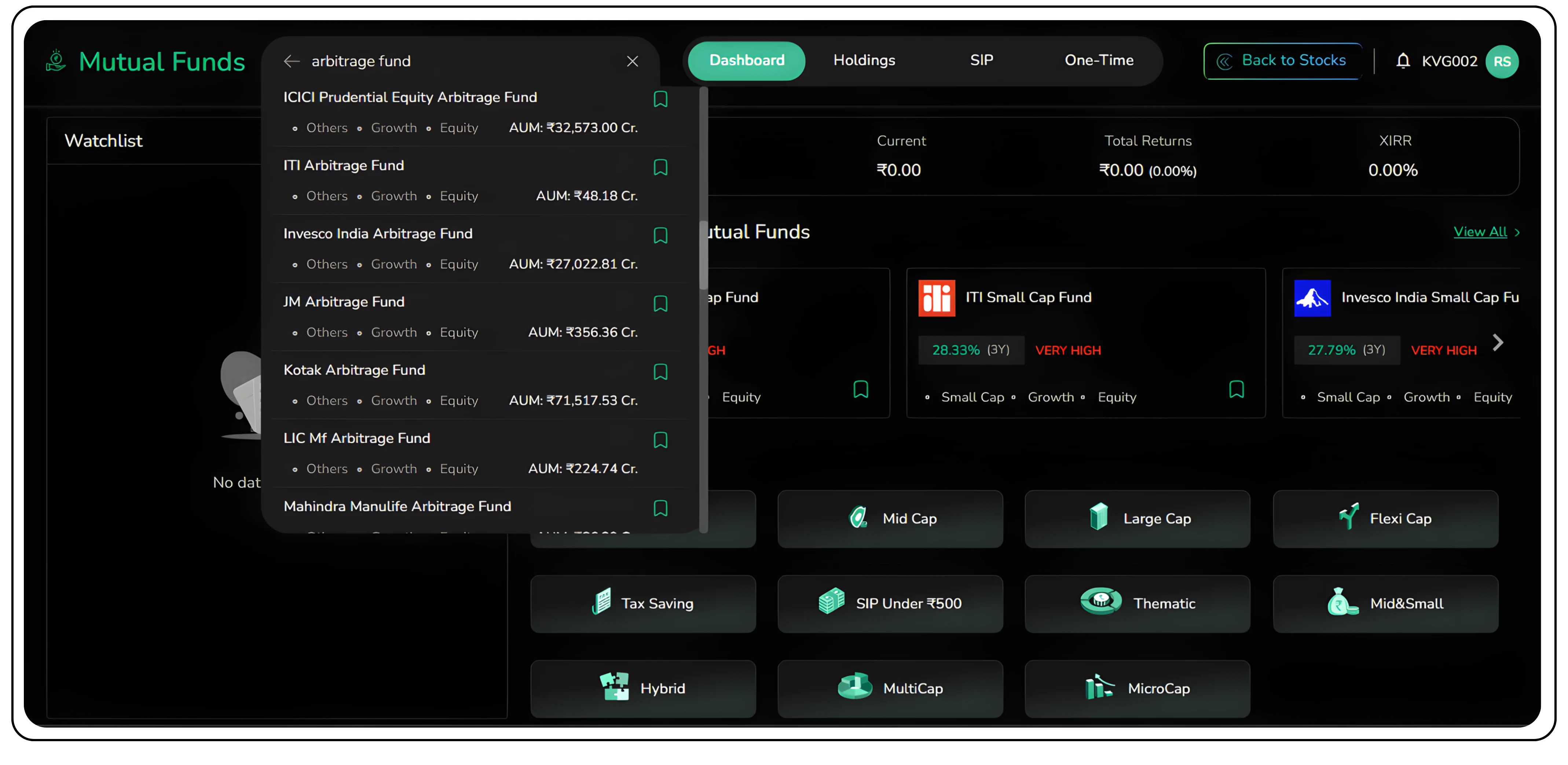
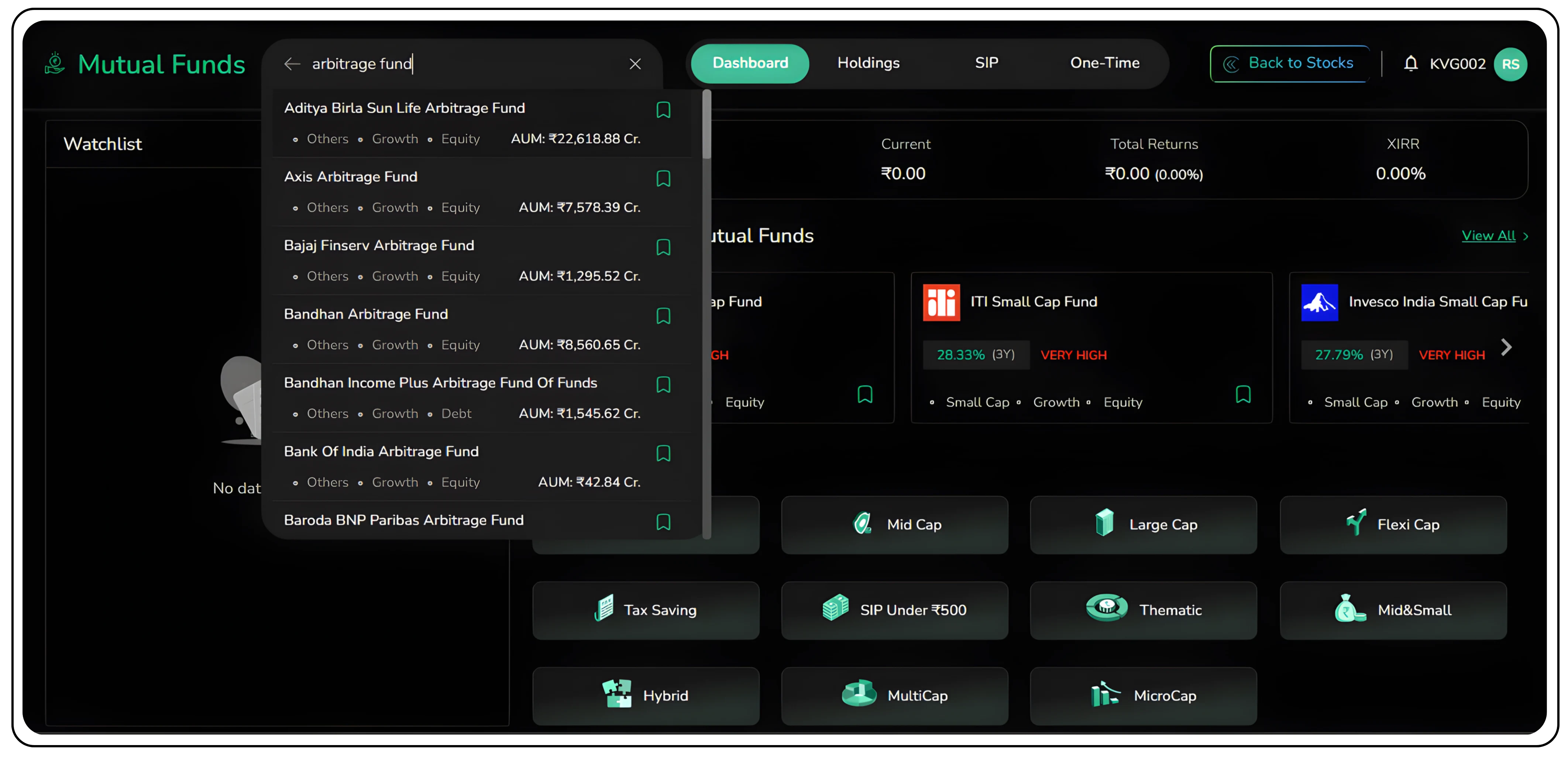
List of Arbitrage Mutual Funds
Benefits of Arbitrage Mutual Funds
Low Risk
Arbitrage mutual funds carry minimal market risk because both buy and sell positions are taken at the same time. This means any gain or loss in one leg is offset by the other. The only real risk comes from execution delays or sudden changes in spreads, which are usually minor.
Steady Returns
Profits from each arbitrage trade are small but add up over time as the fund executes hundreds of such trades across multiple stocks. This makes returns stable and predictable compared to traditional equity funds.
Tax Efficiency
Even though arbitrage funds behave like low-risk debt instruments, they are classified as equity funds for taxation purposes. This gives them arbitrage fund taxation benefits short-term gains taxed at 15% and long-term gains at 10% above ₹1 lakh often making them more efficient than debt funds for investors in higher tax brackets.
Good for Volatile Markets
Arbitrage opportunities widen when markets are volatile, increasing the chances to capture profitable spreads. Therefore, unlike regular equity funds, arbitrage funds may perform better during turbulence.
High Liquidity
These are open-ended schemes, allowing investors to buy or redeem units on any business day. The flexibility makes them useful for short-term parking and portfolio diversification.
Final Thoughts
Arbitrage mutual funds are a safe haven for investors seeking stable returns without taking large market risks. By executing the cash vs futures arbitrage strategy, these funds deliver steady and tax-efficient returns, especially during volatile periods. For individuals looking for low-risk equity fund India options and consistent income, arbitrage mutual funds offer a balanced approach between safety and opportunity.
Start your smart investing on CubePlus and take control of your financial goals.
Disclaimer: The information provided in our blogs is for informational purposes only and should not be construed as financial, investment, or trading advice. Trading and investing in the securities market carries risk. Always conduct your own research and consult with a qualified financial advisor before making any investment decisions. Past performance is not indicative of future results. Copyrighted and original content for your trading and investing needs.
© 2025 — Tradejini. All Rights Reserved.