


Mutual funds are not a single product but a broad family of schemes that cater to different needs. They can be grouped based on their structure or their investment objective.
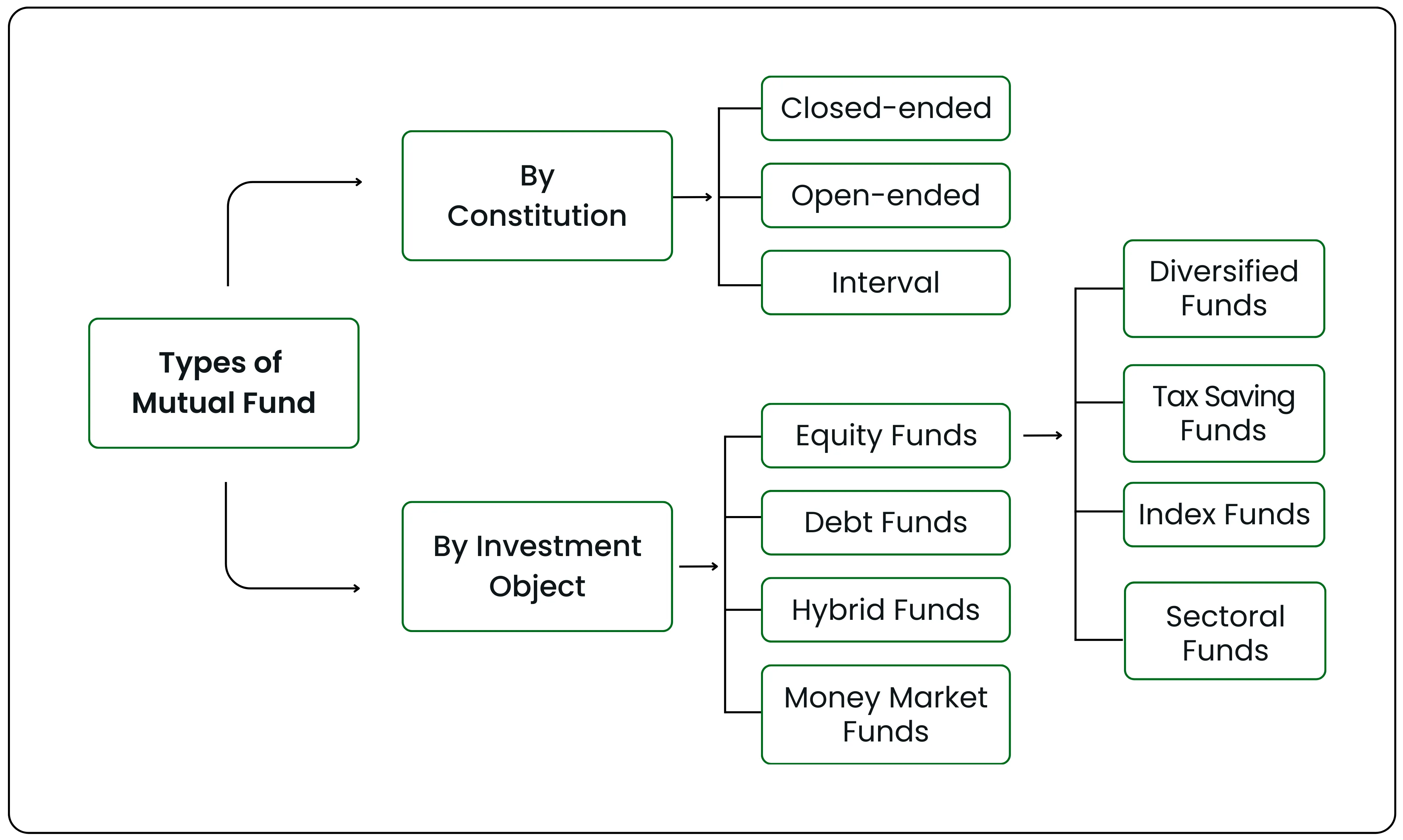
Based on Structure
Open-Ended Schemes
These funds don’t have a maturity date. Investors can buy or redeem units at any time directly from the fund house at prices linked to the Net Asset Value (NAV). The biggest advantage is liquidity. You have never locked in. For instance, if you invest ₹20,000 in SBI Bluechip Fund (open-ended), you can redeem your units after a year, five years, or even ten years, whenever you need money.
Close-Ended Schemes
Close-ended funds come with a fixed maturity, usually between 2 to 15 years. You can invest only when the scheme is launched (during the New Fund Offer), after which units are listed on stock exchanges and traded like shares. Prices on exchanges may differ from the NAV because of demand and supply. For example, ICICI Prudential Infrastructure Fund (close-ended) launched with a 5-year term. If you missed the NFO, your only option to buy units was through the stock exchange, where prices could be lower or higher than the NAV. Interestingly, many close-ended schemes trade at a discount, but this gap narrows as maturity approaches.
Interval Schemes
Interval funds are a mix of open- and closed-ended schemes. They open for subscriptions and redemptions only at fixed intervals, say, every quarter or half-year. Suppose you hold an interval debt fund that opens for redemption every six months. You can only sell units during that window, not anytime you like.
Your Quick Guide to Investing in Mutual Funds on Tradejini
Based on Investment Objective
Equity or Growth Schemes
These funds aim for long-term capital appreciation by investing mainly in shares. The returns are higher compared to debt funds, but so is the risk. For example, Mirae Asset Emerging Bluechip Fund invests in mid-cap and large-cap stocks and is ideal for someone investing with a 7–10 year horizon.
Diversified Equity Funds
These funds spread money across multiple sectors to reduce risk. A common category here is ELSS (Equity Linked Savings Scheme), which gives tax benefits under Section 80C (up to ₹1.5 lakh) but comes with a 3-year lock-in. For instance, Axis Long Term Equity Fund is a well-known ELSS where your money is locked, but you also save on taxes while investing in equities.
Index Funds
These mirror an index like the Nifty 50 or Sensex, so returns are nearly identical to the market index. Since there’s no active management, costs are low. If you buy the Nippon India Index Fund – Nifty 50, your returns will track Nifty’s performance almost exactly.
Sector or Thematic Funds
These focus only on a particular industry, like IT, Pharma, or FMCG. They can give very high returns if the sector does well but carry concentrated risk. For instance, SBI Pharma Fund soared when healthcare stocks outperformed during COVID-19, but would struggle if the pharma sector slows down.
Debt or Income Schemes
These funds invest in fixed-income instruments like government bonds, debentures, and treasury bills. They aim to provide a steady income with lower risk compared to equity. However, their NAVs move with interest rates, when interest rates fall, bond prices rise, and so does the NAV of debt funds. For example, HDFC Short Term Debt Fund is often used by conservative investors who want stability rather than aggressive growth.
Want to catch up on Part 4 of the series before this? Read it here.
Mutual Fund Benefits and Limitations
Hybrid Funds
As the name suggests, hybrid funds invest in a mix of equities and debt to balance growth with stability.
Balanced Funds: These hold nearly equal amounts of equity and debt. HDFC Balanced Advantage Fund is a popular choice that manages exposure dynamically.
Growth-and-Income Funds: These combine growth stocks with dividend-paying ones. They carry less risk than pure equity funds but more than debt funds.
Asset Allocation Funds: Here, fund managers actively switch between equity, debt, or even commodities depending on market outlook. For instance, ICICI Prudential Asset Allocator Fund can shift more towards debt when equity markets look overheated, and vice versa.
###Money Market or Liquid Funds These invest in short-term instruments like Treasury Bills, Commercial Papers, and Certificates of Deposit. They are highly liquid and considered safe, making them suitable for parking surplus money. For example, if you sell your car and want to park ₹5 lakh safely until you buy a new one in six months, an ICICI Prudential Liquid Fund can earn you more than a savings account with very low risk.
- Fixed Maturity Plans (FMPs): A subtype of debt funds, these have a fixed tenure and invest in bonds maturing at the same time. For instance, a 3-year FMP investing in corporate bonds gives predictable returns if held till maturity.
Commodity Funds
These invest in commodities like gold, silver, or crude oil. Gold ETFs are the most popular in India. Nippon India Gold BeES, for example, allows you to invest in gold prices without physically holding the metal.
Real Estate Funds
These funds invest in property-related assets, housing finance companies, or real estate projects. In India, REITs (Real Estate Investment Trusts) are gaining traction. Embassy Office Parks REIT, for instance, invests in office spaces and distributes rental income to investors.
Smart Choice
When you start exploring mutual funds, you will come across many types of mutual funds designed for different goals. Broadly, these can be understood as kinds of mutual funds based on structure or investment objective. Beginners often ask about the 4 types of mutual funds or the four types of mutual funds most commonly used equity, debt, hybrid, and money market. But in reality, there are different types of mutual funds and even more different categories of mutual funds, each catering to unique needs like growth, stability, or liquidity. If you’re comparing mf types, think of them as different mutual fund categories or even various types of mutual fund schemes, ranging from equity-heavy growth funds to debt-oriented income funds. Essentially, the right fund type in mutual fund investing depends on your risk appetite, time horizon, and goals.
Each type of mutual fund serves a unique purpose. Equity funds can help build long-term wealth, debt funds offer stability, hybrids strike a balance, and liquid funds take care of short-term needs. The key is to match the right fund with your goals and time horizon.
Begin your investing journey with CubePlus and take smarter steps toward your financial goals.
Disclaimer: The information provided in our blogs is for informational purposes only and should not be construed as financial, investment, or trading advice. Trading and investing in the securities market carries risk. Always conduct your own research and consult with a qualified financial advisor before making any investment decisions. Past performance is not indicative of future results. Copyrighted and original content for your trading and investing needs.
© 2025 — Tradejini. All Rights Reserved.