

When picking a mutual fund, what is the first metric you look at? Most investors naturally zero in on historical returns, the total expense ratio (TER), or the fund manager's track record. But there is another crucial, often overlooked metric working behind the scenes that reveals exactly how your fund is being managed, and what hidden costs might be eating into your returns. This brings up the question: What is the portfolio turnover ratio in mutual funds?
That metric is the Portfolio Turnover Ratio (PTR). Understanding what is the difference between TER and PTR in mutual funds is essential for any investor.
Much like understanding the hidden costs in ETFs or the power of stepping up your SIPs, grasping the concept of PTR gives you a clearer, more transparent view of your investments. Here is a complete breakdown of what PTR is, how it works, and why it matters.
What is Portfolio Turnover Ratio (PTR)?
Let us explain portfolio turnover ratio in simple terms.
In simple terms, the Portfolio Turnover Ratio measures how frequently a fund manager buys and sells securities within a mutual fund over a given year. It indicates the fund's trading activity level.
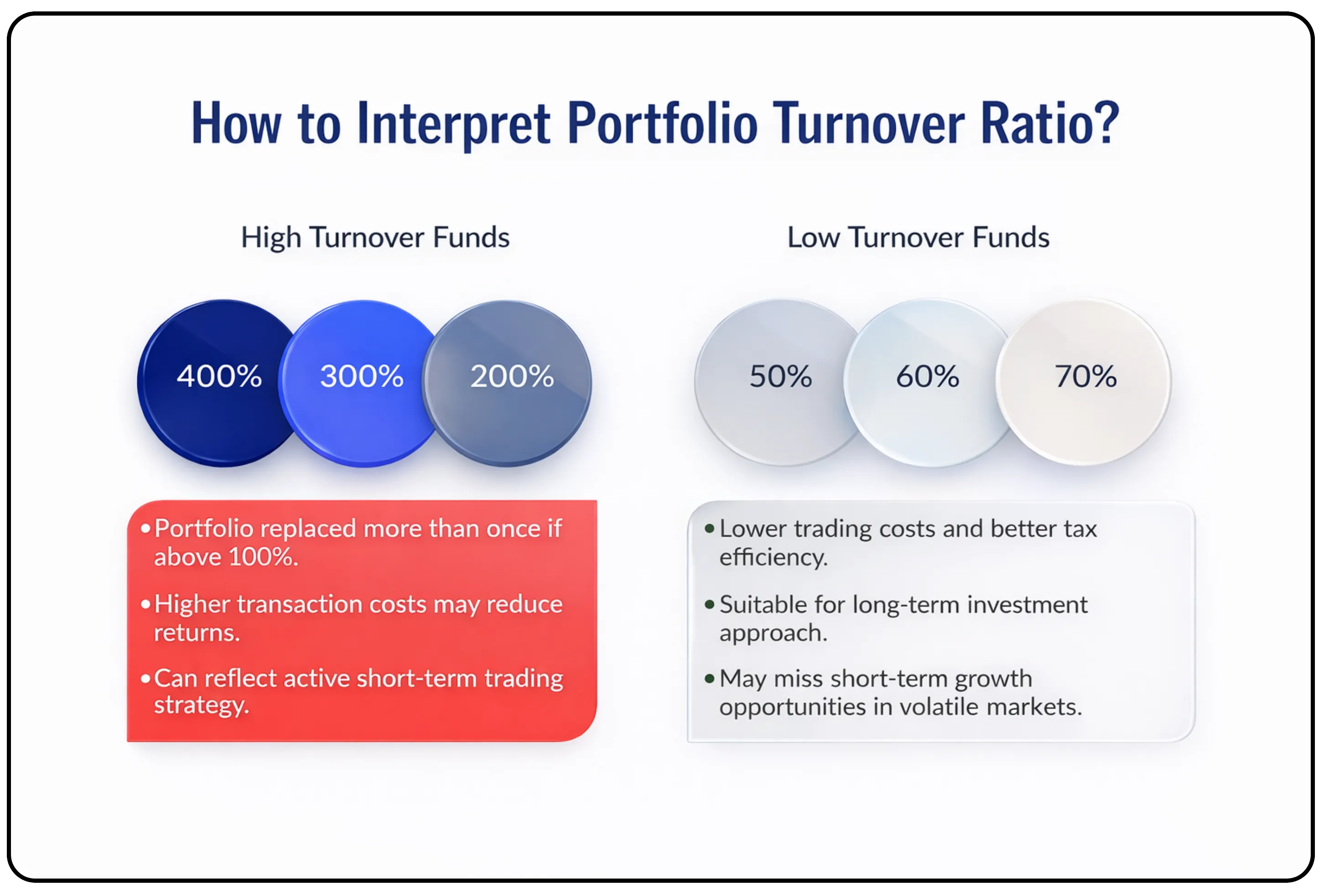
A High PTR means the fund manager is actively buying and selling stocks, constantly shuffling the portfolio to capture market opportunities.
A Low PTR indicates a "buy-and-hold" strategy, where the manager buys stocks with a long-term view and rarely sells them.
How is it calculated?
The formula is straightforward. It is calculated by taking the lesser of the total securities purchased or sold over a year, divided by the fund's average Net Assets Under Management (AUM) for that same period.
High PTR vs. Low PTR: What is the Manager’s Strategy?
PTR is one of the best indicators of a fund manager's underlying investment philosophy.
The Aggressive Approach (High PTR)
A fund with a high turnover ratio is highly active. The manager is likely trying to time the market, capitalizing on short-term price movements, momentum, or changing economic cycles. While this can sometimes lead to market-beating returns in a volatile environment, it requires high conviction and precise timing.
Also read: Global Mutual Funds | What Indian Investors Often Overlook
The Conviction Approach (Low PTR)
A low turnover ratio suggests a long-term, value-oriented, or growth-oriented strategy. The manager identifies fundamentally strong companies and holds onto them through market ups and downs, allowing compounding to do the heavy lifting. Index funds and passive ETFs naturally have very low PTRs because they only trade when the underlying index changes. Investors often ask which mutual funds have the lowest portfolio turnover ratio, and the answer typically points to these passive funds.
The Hidden Costs of High Turnover
Here is where PTR connects directly to your actual returns. You might ask: How does fund manager trading affect my returns? Every time a fund manager buys or sells a stock, there are transaction costs involved. These include:
Brokerage Fees: Paid to execute the trades.
Securities Transaction Tax (STT): Levied on equity transactions in India.
Impact Costs: The price difference that occurs when a large institutional order moves the market price of a stock. It is important to know the impact cost in mutual fund trading in India to fully grasp these deductions.
Crucially, these transaction costs are not included in the Total Expense Ratio (TER). They are deducted directly from the fund's Net Asset Value (NAV). Therefore, a fund with a very high PTR could be racking up hidden transaction costs that drag down its overall performance, even if its stated expense ratio seems reasonable. This addresses the common concern: Does high PTR mean high hidden costs in mutual funds? Ultimately, this demonstrates how portfolio turnover ratio affects mutual fund returns.
Context is Everything: Is High PTR Always Bad?
One must consider whether a high portfolio turnover ratio is bad for investors. It is a common misconception that a high PTR is inherently bad. The "ideal" turnover ratio depends entirely on the category of the mutual fund.
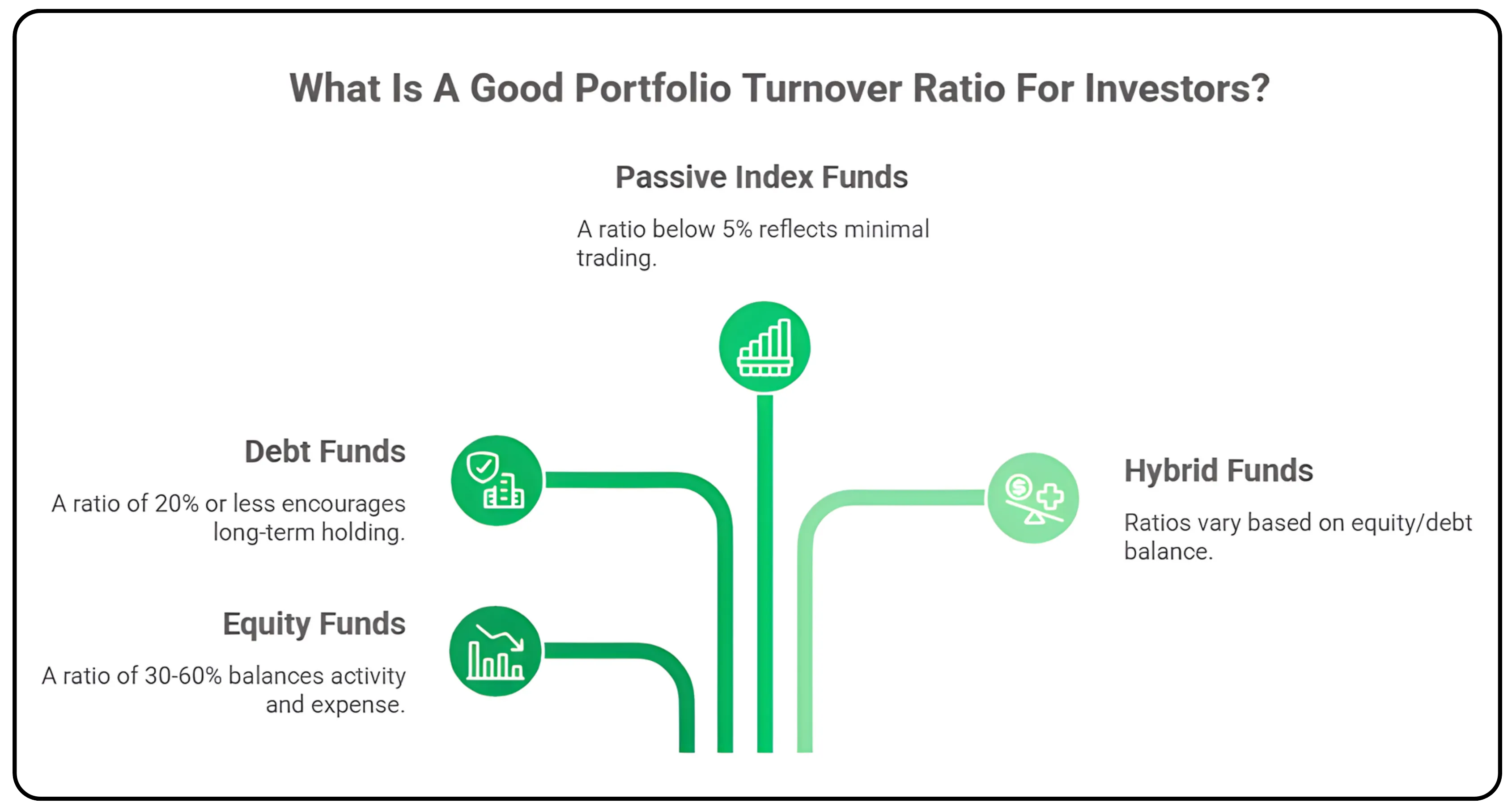
Arbitrage Funds: These funds exploit tiny price differences between the cash and derivatives markets. By nature, they require constant, rapid-fire trading. A PTR of 200% or 300% is expected here. This clearly explains why arbitrage funds have a high turnover ratio.
Large-Cap Index Funds: These should have a very low PTR (often below 5-10%), as they only mirror an index. A high PTR here would be a red flag indicating tracking error or inefficiency. So, what is a good portfolio turnover ratio for index funds? Usually, it is in the single digits.
Flexi-Cap or Small-Cap Funds: These might have a moderate-to-high PTR as managers navigate liquidity constraints or shift allocations between market caps to find growth.
If a high-turnover fund consistently beats its benchmark after accounting for all transaction costs, the manager's active trading is justified. However, if a fund has high turnover and still underperforms, investors are essentially paying for unproductive trading. Knowing this shows you how to compare mutual funds using the portfolio turnover ratio. It also guides you on how to choose a mutual fund based on PTR.
The Bottom Line
The Portfolio Turnover Ratio isn't a standalone metric to base your entire investment decision on, but it is a powerful diagnostic tool. It tells you if the fund manager's actual behavior matches the fund's stated objective. You might be wondering how to check the portfolio turnover ratio of a mutual fund.
Before committing to an active mutual fund, take a moment to look up its PTR in the fund's monthly fact sheet. Knowing how to find PTR in a mutual fund fact sheet is a valuable skill for any investor. Understanding how often your fund manager trades can help you avoid unnecessary hidden costs and align your portfolio with your true investment philosophy.
Also read: Why Increasing Your SIP Every Year Changes Everything
Disclaimer: The information provided in our blogs is for informational purposes only and should not be construed as financial, investment, or trading advice. Trading and investing in the securities market carries risk. Always conduct your own research and consult with a qualified financial advisor before making any investment decisions. Past performance is not indicative of future results. Copyrighted and original content for your trading and investing needs.
© 2026 — Tradejini. All Rights Reserved.