

Tax-saving mutual funds, ELSS mutual funds or equity-linked savings schemes- have always been popular among Indian investors. They combine tax benefits with the potential for long-term wealth creation, offering an investment tool that is simple, effective, and accessible. With the rise of the new tax regime, where ELSS mutual funds no longer qualify for tax deductions under Section 80C, it is natural for investors to question whether ELSS still makes sense in 2025. Let us explore what has changed and whether ELSS funds continue to be a smart choice for your investment strategy.
What is ELSS and why does it matter
Equity Linked Savings Schemes (ELSS) are eligible for deduction under Section 80C of the Income Tax Act under the old tax regime. As the name suggests, this is an equity- linked scheme, and hence the scheme invests in equity shares. The benefit is available up to ₹1.50 lacs per year per taxpayer in case of individuals and HUFs.
The minimum investment amount in an ELSS fund can be as low as ₹500, making it easy to start. ELSS mutual funds also come with the shortest mandatory lock-in period and other tax-saving investments, just 3 years. Compare this with 5 years for tax-saving fixed deposits or 15 years for Public Provident Fund (PPF), and ELSS becomes an attractive option for those seeking quicker liquidity with equity exposure and long-term wealth creation.
How the new tax regime affects ELSS schemes
Under the new tax regime, the benefits offered by ELSS investments have changed. Tax deductions under Section 80C are no longer available if you choose the new regime. That means your ELSS mutual funds will not reduce your taxable income. This is important for anyone who is investing in ELSS mainly for tax savings.
However, the long-term benefits of ELSS mutual funds are not entirely lost. Many investors continue investing in ELSS for its potential to deliver strong returns through equity investments. If you are focused on long-term wealth creation rather than just a tax rebate, ELSS funds remain a viable choice under the new tax structure.
Why ELSS mutual funds are still worth considering
Growth potential
ELSS funds are equity-based, which means they invest in the stock market. Over time, equities have shown strong growth, and that makes ELSS a great option for long-term wealth creation.
Three-year lock-in works in your favor
A lot of people see the lock-in period as a drawback, but for ELSS, it can actually be a good thing. Equity investments usually do better when held for a longer time. A three-year lock-in encourages investors to stay invested, which often leads to better returns.
Track record
Historically, ELSS funds have delivered good returns. Over the past three years, the average return across ELSS funds has been around 15%.That is still better than most fixed-income options.
Flexible investment modes
You can invest in ELSS however it suits you,either through a lump sum or a Systematic Investment Plan (SIP). With SIPs, you can start small, even ₹500 a month. Plus, since you are investing regularly, you get the benefit of rupee cost averaging, which means you automatically buy more units when prices are low and fewer when prices are high.
Tax benefit still available, if you want it
Just because the new tax regime does not offer Section 80C benefits does not mean ELSS has lost all tax perks. If you want to claim a deduction on your ELSS investment, you can simply choose the old tax regime. Under that, ELSS still qualifies for tax savings up to ₹1.5 lakh per year.
What makes a strong ELSS mutual fund
When choosing an ELSS mutual fund, here are a few points to consider for aligning with your investment goals:
Fund’s performance: Look at consistent returns over multiple financial years. Avoid selecting based only on one year’s capital gains.
Experienced fund managers: A professional fund manager can make better decisions, helping you manage market volatility effectively.
Portfolio diversification: A mix of large-cap, mid-cap, and sometimes small-cap stocks reduces concentration risk and improves the fund’s performance.
Rolling returns: This helps evaluate how ELSS mutual funds perform across market cycles, not just in favourable conditions.
Rupee cost averaging: A systematic investment plan in ELSS reduces the impact of market risks by spreading your investment amount over time.
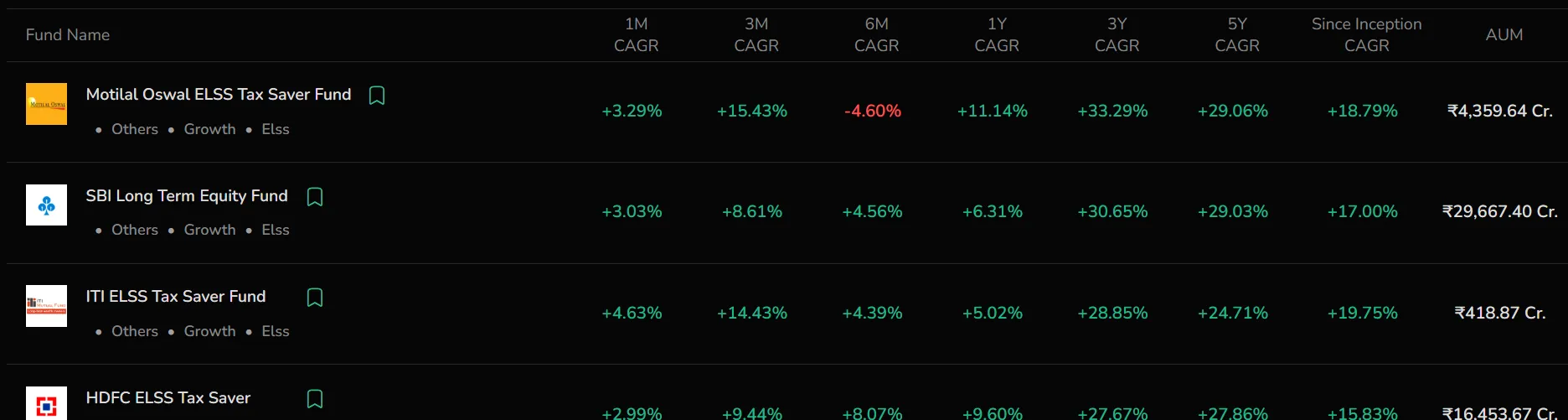
Performance of ELSS mutual funds 2025
Introduction to ELSS Funds
ELSS (Equity Linked Savings Scheme) funds are a unique category of mutual fund designed to help investors save on taxes (only if they opt for the old regime) while building long-term wealth. These funds primarily invest in equity and equity-related instruments, offering the potential for significant capital appreciation over time. One of the defining features of ELSS funds is the mandatory lock-in period of three years, which not only encourages disciplined investing but also helps investors ride out short-term market volatility.ELSS funds have become a preferred option for individuals looking to optimize their investment portfolio.
Benefits of Investing in ELSS
Investing in ELSS funds comes with a host of benefits that make them stand out among other tax-saving options.First and foremost, ELSS funds qualify for a tax rebate of up to ₹ 1.5 lakh under Section 80C under old tax regime, which can translate into tax savings of up to ₹ 46,800 in a financial year. Unlike many other tax-saving investments, ELSS funds have a relatively short lock-in period of just three years, giving investors quicker access to their invested capital. Additionally, because ELSS funds invest in equities, they offer the potential for higher returns compared to traditional tax-saving instruments like fixed deposits or savings certificates. For those with a long-term investment horizon, investing in ELSS funds can be an effective way to achieve wealth creation. Whether you are new to investing or looking to diversify your tax-saving investments, ELSS funds provide a flexible and rewarding option.
How ELSS Mutual Funds Work
ELSS mutual funds operate by allocating a significant portion of their assets to equity and equity-related instruments, aiming to generate long-term capital growth. These funds are managed by experienced fund managers who carefully select stocks and other equity-related securities to maximize returns while managing risk. A key feature of ELSS mutual funds is the mandatory lock-in period of three years, during which investors cannot redeem their units. After this period, investors have the flexibility to stay invested for further growth or redeem their holdings as per their financial needs. ELSS mutual funds also offer the convenience of systematic investment plans (SIPs), allowing investors to contribute a fixed amount at regular intervals. This approach not only makes investing more accessible but also leverages rupee cost averaging, helping to smooth out the impact of market volatility over time. By staying invested and making use of SIPs, investors can build a disciplined approach to wealth creation through ELSS mutual funds.
Features of ELSS Mutual Funds
ELSS mutual funds come with several features that make them an attractive choice for tax-conscious investors. One of the most notable is the mandatory lock-in period of three years, which is the shortest among tax-saving mutual fund schemes. ELSS funds also provide flexibility in how you invest, whether through a lump sum investment or via systematic investment plans (SIPs), catering to different financial preferences and goals. With a relatively low minimum investment requirement, ELSS mutual funds are accessible to a broad range of investors, from beginners to seasoned market participants. The potential for high returns and flexible investment options makes ELSS funds a compelling addition to any investment portfolio, even with three year lock in period.
Comparison with Other Tax Saving Options
When compared to other tax-saving options like Public Provident Fund (PPF), National Savings Certificate (NSC), and National Pension System (NPS), ELSS funds offer several distinct advantages. The lock-in period for ELSS funds is just three years, which is significantly shorter than the 5 to 15 years required by many other tax-saving instruments. While options like PPF and NSC provide fixed returns, ELSS funds offer the potential for capital appreciation through equity market exposure. This makes them especially appealing for investors with a higher risk appetite and a long-term perspective. Additionally, ELSS funds offer tax benefits under Section 80C, helping to reduce taxable income and maximise tax savings. The flexibility to invest either as a lump sum or through SIPs, combined with the opportunity for higher returns, positions ELSS funds as one of the most attractive tax-saving investments available for those who opt for the old regime. Whether you are looking to diversify your tax-saving portfolio or seeking higher growth potential, ELSS funds offer a compelling alternative to traditional tax-saving instruments.
ELSS Fund
When comparing these funds, investors should also consider the net asset value (NAV) of each fund, as it reflects the per-unit value based on total assets and can help in making informed investment decisions.
Why ELSS remains a smart choice for long-term wealth creation
Even without the tax benefits offered under the old regime, ELSS mutual funds provide equity exposure, which is key for long-term wealth creation but also introduces market risk. ELSS mutual funds provide exposure to equity markets with potential for capital appreciation. Investing in ELSS with a longer investment horizon, beyond the 3-year lock-in, can lead to higher returns. Investors should remain invested for 5 to 7 years to create wealth while managing risk tolerance.
Also, since ELSS funds invest in underlying securities linked to the stock market, they come with market volatility. But over time, volatility evens out, especially when investing through SIPs. You can invest in ELSS funds either through SIP or lump sum, as the ELSS mutual fund scheme allows both investment modes. It helps mitigate market volatility and instills disciplined investing habits.
Ideas to optimise your ELSS investments
Stick to one or two schemes: Avoid cluttering your portfolio with multiple ELSS schemes. A focused approach improves clarity and performance tracking.
Understand risk factors: Like all equity-linked instruments, ELSS comes with market risks, interest rate risk, and liquidity risk. Review the scheme-related documents carefully.
Match investment to your goals: Align your ELSS investments with long-term financial goals such as retirement planning or children’s education.
Opt for SIPs: A systematic investment plan helps in rupee cost averaging, especially when investing in ELSS mutual funds over time.
Consider the expense ratio: When selecting the best ELSS funds, compare the expense ratio, as a lower expense ratio can improve your net returns.
Review the fund manager and fund houses: Check the track record of the fund manager and the reputation of the fund houses when choosing an ELSS scheme.
Compare ELSS mutual fund investment strategies: Look at how ELSS mutual funds invest, including their allocation across large, mid, and small-cap stocks.
Understand the year lock-in period: ELSS funds require a mandatory three-year lock-in period, which is shorter than many other savings schemes, and promotes disciplined, long-term investing.
Evaluating ELSS for long-term wealth
So, are ELSS mutual funds still worth it in 2025? The answer depends on your tax preferences and investment horizon. Under the old tax regime, ELSS remains one of the best tax-saving mutual funds available. Under the new tax regime, while the tax deduction is no longer available, the equity-linked savings scheme still provides exposure to growth-oriented equity markets.
Capital gains from ELSS are taxed based on the holding period: if redeemed before three years, short-term capital gains tax applies; after three years, long-term capital gains are taxed, with gains up to ₹1 lakh per year being tax-exempt. ELSS is a type of equity fund and equity-linked savings scheme, and is considered one of the best ELSS mutual funds for tax-saving investment options in India. The best ELSS mutual fund for you depends on your investment goals, risk tolerance, and whether you prefer to invest in ELSS via SIP or lump sum. ELSS tax saver fund and India ELSS tax saver options are available from top mutual fund houses, and these mutual fund schemes are designed for Indian investors seeking tax-saving investment and long-term equity investing.
Whether you choose ELSS for tax-saving instruments or as a route to long-term wealth creation, it is important to evaluate the risk involved, read the scheme-related documents, and understand your risk tolerance. ELSS mutual funds work best when used thoughtfully and with a clear investment strategy.
Disclaimer: The information provided in our blogs is for informational purposes only and should not be construed as financial, investment, or trading advice. Trading and investing in the securities market carries risk. Always conduct your own research and consult with a qualified financial advisor before making any investment decisions. Past performance is not indicative of future results. Copyrighted and original content for your trading and investing needs.
©️ 2025 — Tradejini. All Rights Reserved.