

Most Indian investors build their entire portfolio within Indian borders. Equities listed on the NSE and BSE, debt from domestic issuers, gold held locally. It feels familiar and controllable. But the global economy does not operate on the same calendar as Dalal Street, and that gap is precisely where global mutual funds enter the picture.

What a Global Mutual Fund Actually Does
A global mutual fund is a fund that invests in equities or debt instruments listed outside India. When you invest in one, your money travels. It may end up in shares of Apple or Microsoft, in semiconductor companies listed in Taiwan, in consumer brands headquartered in Europe, or in a diversified basket spread across dozens of countries. The underlying holdings are priced in foreign currencies, listed on foreign exchanges, and subject to the economic conditions of those geographies.
This is the foundational point from which everything else follows.
The Currency Dimension Changes Everything
Because the underlying assets are priced in foreign currencies, your returns as an Indian investor are not just a function of how those assets perform. They are also a function of how the Indian rupee moves relative to those currencies.
If you are invested in a US-focused fund and the rupee depreciates against the dollar, your NAV in Indian rupee terms rises even if the US market is flat. The reverse is also true. A strong rupee can erode returns that look attractive in dollar terms.
For example, assume you invest in a US-focused fund and the underlying market delivers 8% returns in dollar terms. If, during the same period, the Indian rupee depreciates by 4% against the dollar, your effective return in rupee terms moves closer to 12%.
On the other hand, if the rupee strengthens, it can reduce your overall returns even if the underlying market performs well.
This currency component is neither a feature nor a flaw. It is simply how the instrument works. Historically, the rupee has depreciated against the dollar over long periods, which has added a tailwind to returns from US-focused funds for Indian investors. But that trend is not guaranteed to continue in any given time frame, and investors need to account for this layer of variability when they interpret fund performance.
Your Quick Guide to Investing in Mutual Funds on Tradejini
Geographic Diversification and Why It Is Structurally Different
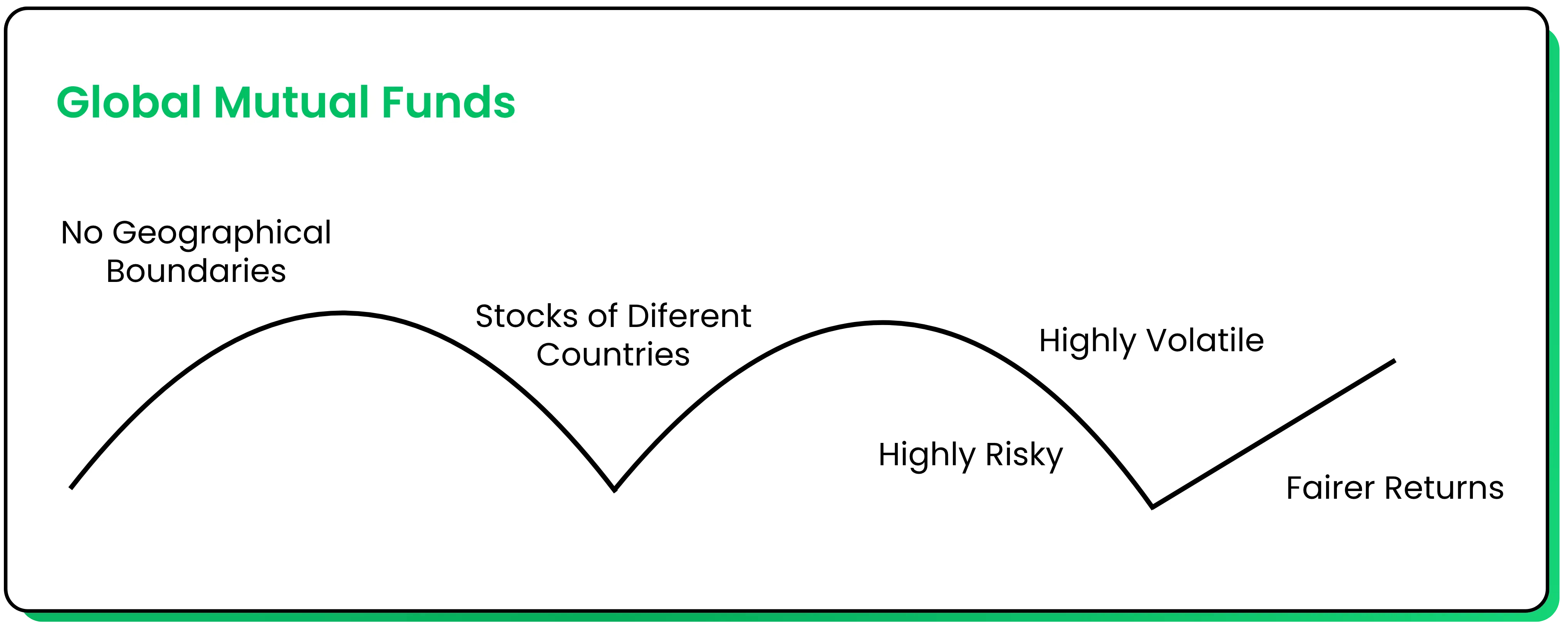
The more significant argument for global funds is not currency but correlation. Different economies move through their cycles at different times and for different reasons. When India's markets are under pressure due to domestic inflation or fiscal concerns, the US market may be rallying on the back of technology earnings. When emerging markets are struggling, developed market funds may hold steady.
This low correlation between geographies means that adding a global fund to a portfolio can reduce overall volatility in a way that adding more Indian equity funds simply cannot. You are not just adding more assets; you are adding assets that respond to a different set of economic triggers. That structural difference is what gives global diversification its value.
The Regulatory and Tax Reality
SEBI regulates how much Indian mutual funds can invest abroad. The industry-wide limit is set at $7 billion, and when that ceiling is approached, fund houses temporarily stop fresh inflows into their international schemes. This is not a hypothetical concern; several funds have paused subscriptions in the past when the limit was hit, though some continue to allow investments through the $1 billion separate limit for overseas ETFs.
On taxation, global mutual funds no longer follow the "taxed at slab rate regardless of holding period" rule that briefly existed in 2023. Under current rules, since these funds do not invest 65% in Indian equities, they are classified as "Specified Mutual Funds" but retain the benefit of long-term rates if held patiently.
Specifically, if you hold a global mutual fund for more than 24 months, the gains are classified as Long-Term Capital Gains (LTCG) and are taxed at 12.5%. If sold before 24 months, the gains are considered Short-Term Capital Gains (STCG) and are added to your income to be taxed at your applicable slab rate. This creates a distinction from domestic equity funds, which qualify for the 12.5% rate after just 12 months, but it ensures that long-term global investors are no longer penalized with high slab-rate taxes on their entire profit.

The Honest Assessment
Global mutual funds give Indian investors access to companies, sectors, and economies that do not exist in the domestic market. Semiconductors, global consumer technology, European industrials, US healthcare: these are industries where India has limited listed exposure. That access is real and has structural merit.
At the same time, these funds carry currency risk, are subject to regulatory limits on inflows, and do not receive the same tax treatment as domestic equity funds. Understanding all four dimensions together, what the fund holds, how currency affects returns, how it behaves relative to other assets, and how it is taxed, gives an investor an accurate picture of what they are actually signing up for.
Start your mutual fund journey through CubePlus.
Disclaimer: The information provided in our blogs is for informational purposes only and should not be construed as financial, investment, or trading advice. Trading and investing in the securities market carries risk. Always conduct your own research and consult with a qualified financial advisor before making any investment decisions. Past performance is not indicative of future results. Copyrighted and original content for your trading and investing needs.
© 2026 — Tradejini. All Rights Reserved.