







Open Interest (OI) is one of the most powerful tools to assess trader sentiment. When paired with price action, it can reveal what's happening beneath the surface of the market. But like all tools, it can mislead if not used correctly.
What is Open Interest?
Open Interest in options refers to the total number of outstanding derivative contracts that haven’t been settled. Whether it’s futures or open interest in options, this metric tells us about liquidity and trader participation. It tells us about liquidity, trader participation, and market sentiment.
The 4 classic OI + Price combinations
| Scenario | Price | OI | Interpretation |
|---|---|---|---|
| Long Buildup | ↑ | ↑ | Bullish – new longs being added |
| Short Buildup | ↓ | ↑ | Bearish – new shorts being added |
| Short Covering | ↑ | ↓ | Bullish – shorts are exiting |
| Long Unwinding | ↓ | ↓ | Bearish – longs are exiting |
These patterns reflect trader behavior – whether new positions are being created or old ones are closed.
Live example: Understanding Nxtoptions’ Open Interest
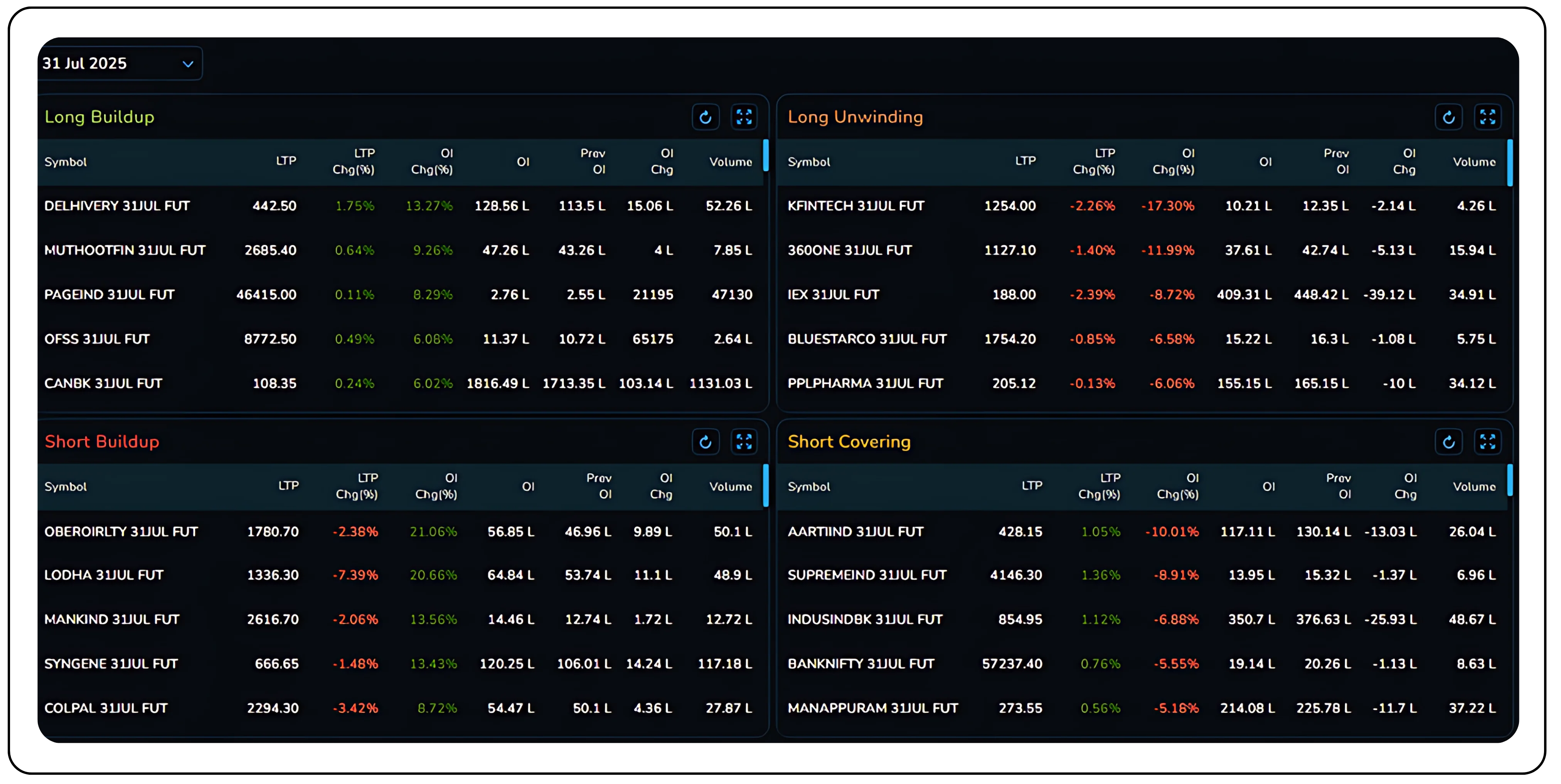
From the Nxtoption screenshot dated 23 July 2025, here’s how we can break it down:
Open Interest and Price Action summary
| Stock Name | LTP Change | OI Change | Interpretation | Signal Type |
|---|---|---|---|---|
| DELHIVERY FUT | ↑ 1.75% | ↑ 13.27% | Traders adding long positions – bullish | Long Buildup |
| CANBK FUT | ↑ 0.24% | ↑ 6.02% | Weak price rise, OI building – cautious long | Long Buildup |
| LODHAFIN FUT | ↓ 7.39% | ↑ 20.66% | Strong price drop with OI spike – bearish | Short Buildup |
| MANKIND FUT | ↓ 2.06% | ↑ 13.56% | Aggressive shorting – negative sentiment | Short Buildup |
| AARTIIND FUT | ↑ 1.05% | ↓ 10.01% | Shorts exiting – early sign of reversal | Short Covering |
| KFINTECH FUT | ↓ 2.26% | ↓ 17.30% | Longs unwinding – bearish sign | Long Unwinding |
Common pitfalls & how things can go wrong
1. Fake signals in low volume stocks
One of the most common and misleading traps in OI and price analysis is the occurrence of fake signals in low volume stocks. These are instruments that experience limited trading activity, resulting in low liquidity and reduced market depth. In such cases, even a handful of large trades can cause disproportionately high changes in both price and open interest. A handful of trades can cause disproportionately high open interest in such cases, giving a false signal.
For example, a small number of contracts can trigger a double-digit percentage increase in OI or create the illusion of a price breakout. However, this movement often lacks genuine market participation or institutional conviction.
Consider the case of OFSS 31JUL FUT, which shows a modest price increase of 0.49% and an OI build-up of over 6%. On the surface, this may look like a classic long build-up, a bullish signal suggesting fresh buying interest. However, the volume tells a different story: just 2.64 lakh contracts. This low activity level makes the signal unreliable, as such a small traded quantity is insufficient to confirm directional sentiment. The reality is that low volume derivatives are highly susceptible to manipulation or price distortion due to wider bid-ask spreads, lower float, and reduced competition among buyers and sellers.
Relying on such data can lead traders into false entries and unexpected reversals. Without strong volume to validate the signal, there is no assurance of sustained follow-through.
To avoid falling into this trap, traders should set minimum volume filters ideally considering only stocks with daily volumes above 10 lakh contracts and consistent open interest levels. It's also important to verify if volume is in line with historical averages and if the instrument shows similar liquidity in the options market.
2. High OI Change from Option Writers
Another major pitfall in interpreting OI data is misreading high open interest build-up caused by option writers or hedgers, rather than directional traders. A sharp increase in OI is often assumed to reflect aggressive buying or selling, signaling bullish or bearish sentiment. However, this assumption can be misleading, especially in the options segment where a large portion of OI is generated by writers (sellers), not buyers. These participants are typically institutions or professionals executing non-directional strategies such as covered calls, straddles, or spreads. Their motive is often to collect premium through theta decay rather than speculate on price movement. Many options traders misunderstand the rise in OI as buying interest when in fact, it’s driven by option writers aiming to profit from range-bound moves.
For instance, an increase in OI at a particular strike might appear to suggest fresh buying interest, but in reality, it could be dominated by call writers anticipating resistance, or put writers expecting support. In such scenarios, the OI build-up is not a directional bet, but rather a positioning tactic that seeks to profit from price staying within a defined range. If a trader misinterprets this activity as a directional signal and takes a trade accordingly, they may end up trading against smart money, not alongside it.
This misjudgment becomes particularly risky during high-volatility periods, such as near expiry or after event-based moves, where hedging activity intensifies. To avoid falling into this trap, traders must study the option chain holistically looking at changes in both Call and Put OI, examining IVs, and evaluating net change in premiums to distinguish between writing and buying activity.
Don’t rely on OI change alone. Always cross-check with:
- Implied Volatility is falling, which is typical post-results.
- Premiums are declining despite OI rising this suggests writing, not buying.
- No significant movement in spot price, indicating neutral sentiment.
3. No confirmation from volume
A rise in open interest without a corresponding increase in trading volume is often a weak or unreliable signal. Trading volume confirms participation; it shows that multiple market participants are actively trading at those levels. If OI increases but volume remains low, the buildup may be due to a few isolated trades rather than broad market conviction. Always ensure that OI changes are supported by healthy volume to validate the strength and reliability of the trend. That’s why volume analysis alongside OI is essential to validate whether the market movement is real or just noise.
4. Intraday OI/Price changes can be misleading
Intraday movements in open interest and price can often reflect short-term volatility rather than genuine trend shifts. These fluctuations may be driven by scalpers, algos, or news-based reactions, and may reverse quickly within the same session. Relying solely on intraday OI data can lead to false signals and premature entries. For more reliable insights, it's best to analyze OI and price action on end-of-day (EOD) or at least hourly timeframes, where trends are clearer and backed by sustained participation.
Step-by-Step Plan to use OI data in trading
Step 1: Identify direction
Use the OI+Price quadrant:
- ↑ Price & ↑ OI = Go Long
- ↓ Price & ↑ OI = Go Short
Step 2: Check volume & historical OI
- Compare with last 3–5 day averages.
- Ensure new OI is not just roll-over or squaring.
Step 3: Select liquid stocks
- Volume > 20L and OI > 10L preferable
Step 4: Use filters on the platform
- Use tabs like “Long Buildup”, “Short Buildup” etc.
- Select instruments with:
- OI Change > 5%
- LTP Change > 0.5%
Step 5: Trade entry timing
- Enter during consolidation breakout (OI confirms)
- Avoid entering after big moves – late signal risk.
Step 6: Track reversals
- Watch for Short Covering and Long Unwinding, often early signs of reversals.
Step 7: Set Stop Loss based on structure
- Use swing high/low or ATR-based stop loss to define exit points clearly.
Open Interest, when paired with price and volume, offers deep insight into trader behavior. But it’s not a silver bullet. Relying on OI alone, without checking volume, context, and who’s actually participating can lead to false signals and bad trades. The key is to treat OI as part of a larger framework: use it to validate price action, spot buildups, and catch early signs of reversals. And always remember, smart money leaves footprints. Your job is to read them, not chase them.
How to access Open Interest data on Nxtoption
Step 1: Navigate to the Open Interest Section
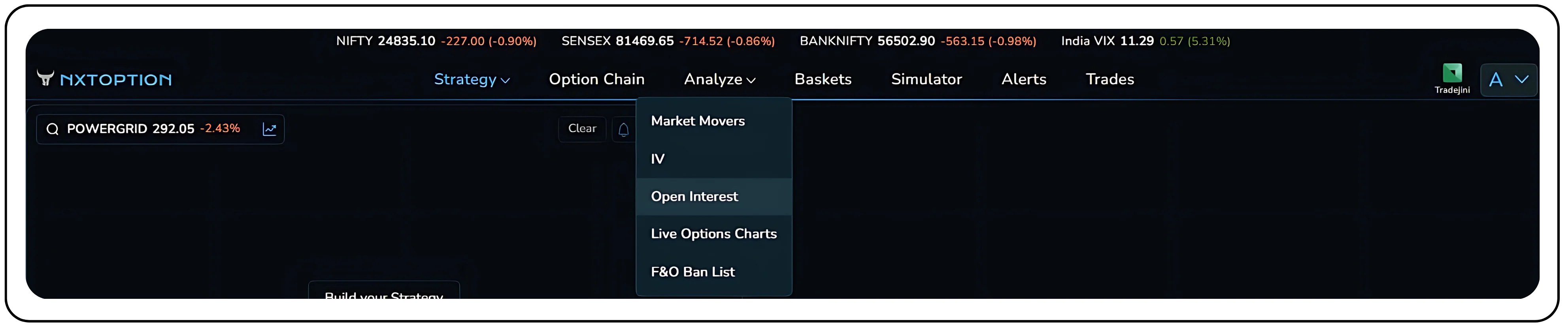
From the top menu on Nxtoption, go to the Analyze tab.
In the dropdown, select Open Interest. This will take you to the OI analytics section, where you can dive into Futures and Options data.
Step 2: View Detailed open interest data by Category
Once inside the Open Interest section, click on OI Futures from the left panel to explore real-time open interest data categorized by trader activity.
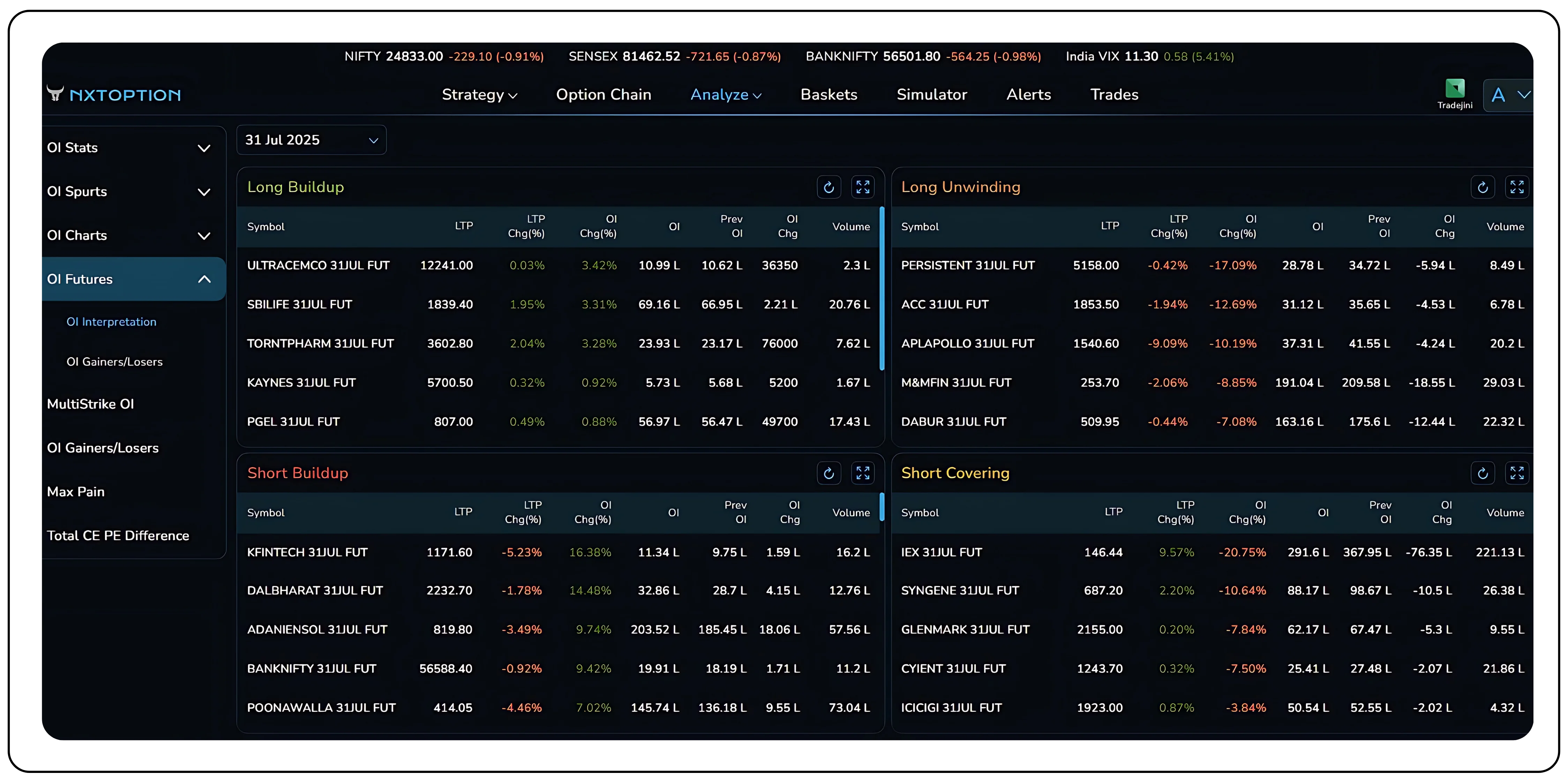
You’ll see real-time data neatly categorized into:
- Long Buildup
- Short Buildup
- Short Covering
- Long Unwinding
Each table gives you key stats like LTP, % change in price, OI change, and volume, making it easy to interpret market sentiment at a glance.
Open your CubePlus account and take the first step toward smart, goal-based investing on your terms. Click here to sign up