


Investing in pharma mutual funds means allocating your money to mutual fund schemes that invest in shares of pharmaceutical and healthcare companies. These funds allow investors to benefit from the growth of India’s healthcare and pharmaceutical sectors without the need to pick individual stocks.

Together, these trends make pharma mutual funds an attractive option for new investors seeking exposure to this vital and expanding sector.
In this article, we will break down these factors in simple terms and explain why they make pharma funds an attractive bet. We will also list some of the top pharma mutual funds in India, along with their recent performance and minimum investment requirements, to help you get started.
Why the Pharmaceutical Sector Looks Promising?
Indians today face more health challenges than ever before. Lifestyle diseases also known as non-communicable diseases such as diabetes, heart disease, and hypertension are rapidly increasing due to changing diets, rising stress levels, and longer life expectancy.
For instance, India has the highest number of people living with diabetes in the world over 212 million. This alarming trend has led to a growing need for continuous medication and long-term healthcare. As more Indians seek treatment for these conditions, pharmaceuticals and medical equipments are well-positioned to benefit.
Increasing Health Awareness and Insurance Coverage
The COVID-19 pandemic served as a major wake-up call, making people more conscious about their health and the importance of financial protection against medical emergencies. As a result, awareness of health insurance has significantly increased, with more individuals now purchasing policies to cover hospitalization and treatment costs.One clear trend is the surge in demand for health insurance top-up plans, which provide additional coverage beyond a basic policy. These plans accounted for approximately 34.6% of total health insurance premiums in FY2023-24, a sharp rise from just 10.5% in FY2018-19.
This shows that Indians are investing more in their healthcare security. With insurance coverage growing, more people can afford treatments and medications instead of avoiding them due to cost. That translates into higher sales for pharmaceutical companies (as insured patients are more likely to buy the medicines or undergo procedures they need). Greater health awareness and insurance adoption thus support the pharma sector’s growth.
Rising Incomes and Willingness to Spend on Health
India’s economy has been growing steadily, leading to higher income levels among its citizens. A rising middle class and greater disposable income mean people are now able to spend more on quality healthcare. Families with better earnings are more inclined to undergo preventive health check-ups, purchase vitamins and health supplements, and choose advanced (albeit more expensive) treatments when necessary.
Simply put, rising income levels drive increased healthcare spending. This creates a favourable environment for pharmaceutical companies, as they gain access to a broader market of customers who can afford their products. As India’s per capita income continues to rise, this trend is expected to strengthen further.
Long-Term Growth Potential of India’s Pharma Sector
The country is often called the ‘pharmacy of the world’ because it is a leading manufacturer of generic drugs (affordable copies of branded medicines) and vaccines. India already supplies a large chunk of the medicines used globally, and this share is set to grow. According to a recent industry report, India’s pharma market (valued at around USD 55 billion currently) is projected to expand to USD 120–130 billion by 2030. That’s more than double in size. This growth will be driven by strong domestic demand as well as exports, Indian companies are exporting medicines to many countries, and that export business is growing steadily. In fact, if these trends continue, India could account for about 5% of the world’s pharmaceutical market by 2030. For an investor, such projections signal strong long-term prospects.
Pharma is typically considered a defensive sector too, meaning that even during economic downturns, people still need to buy medicines, so pharma companies’ earnings are relatively stable. All these factors combine to make pharma-focused funds a potentially resilient and rewarding investment over the long haul.
Supportive Trends and Government Initiatives
Alongside the above factors, several supportive trends are also worth noting. The government has introduced initiatives such as Ayushman Bharat, which aims to provide health insurance to millions of Indians, and has increased its focus on strengthening healthcare infrastructure. More hospitals, medical colleges, and pharmaceutical research centers are being established.
Medical inflation in India remains high around 12–14% annually in recent years which, paradoxically, translates to higher revenues for healthcare businesses. Additionally, the pharmaceutical sector has recently seen strong performance due to favourable currency movements (as a weaker rupee boosts the value of drug exports in rupee terms) and the easing of certain price regulations.
While short-term challenges such as regulatory changes or price caps on medicines may arise, the overall environment continues to be supportive for pharma companies. This favourable backdrop enhances the appeal of pharma mutual funds for investors with a 5–10-year horizon.
Recent Performance of Pharma Mutual Funds
In 2024, pharma and healthcare mutual funds topped the performance charts. On average, pharma funds gained around 21% during the 2024–2025 period, making them the best-performing equity fund category for the year.
For instance, the HDFC Pharma and Healthcare Fund delivered a return of approximately 32.16%, while the ICICI Prudential Pharma Healthcare & Diagnostics Fund gained about 24.4% during the same period. These returns significantly outpaced those of broad-based diversified equity funds and the overall market.
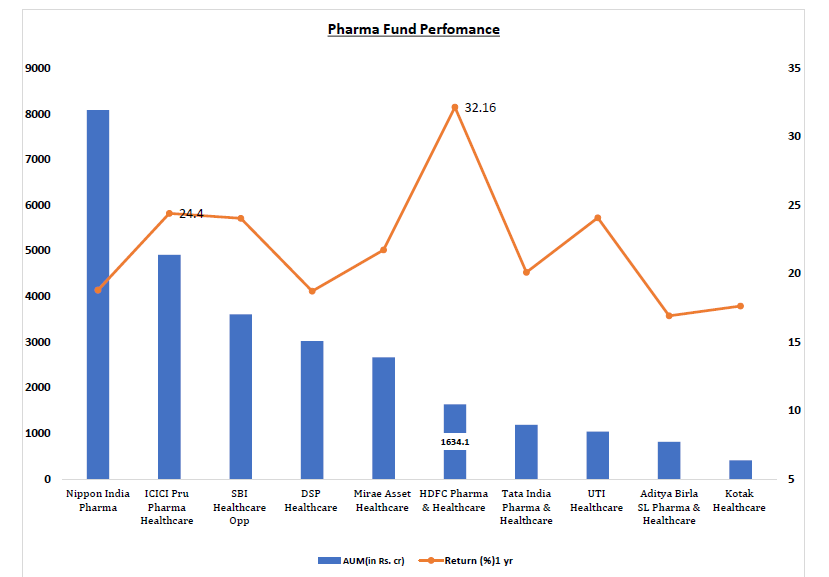
Even over a slightly longer timeframe say 3 years many pharma mutual funds have delivered strong three-year performance as well. For example, the SBI Healthcare Opportunities Fund and ICICI Prudential Pharma Healthcare & Diagnostics (P.H.D) Fund have delivered approximately 23–24% annualized returns over the past three years. In simple terms, if you had invested in these funds three years ago, you would have earned over 20% per year on average, significantly outperforming traditional savings options which give.
Even a more established fund like the Nippon India Pharma Fund, which was launched in 2004, has generated around 20.16% annualized returns.
Top Pharma Mutual Funds in India
If you are convinced about the pharma sector’s potential, you might be wondering which mutual fund schemes to consider. Below is a list of some top pharma mutual funds in India. These funds are managed by reputable fund houses and have a strong focus on pharma and healthcare stocks.
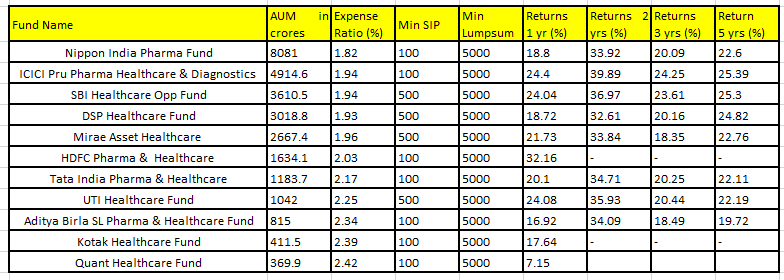
Note: Sector-specific funds like pharma can be more volatile in the short term compared to diversified funds, as they are concentrated in a single industry. It’s advisable to invest with a long-term perspective and not get influenced by short-term fluctuations.
Key Factors Consider
However, it is important to invest with the right expectations.
- Pharma mutual funds are sector-specific and can be more volatile in the short term compared to diversified equity funds. Experts often advise investing in such funds only if you have a high-risk tolerance and a long-term investment horizon.
- It may be prudent to allocate only a moderate portion of your overall portfolio to pharma funds. This approach allows you to benefit from the sector’s growth potential while maintaining diversification and reducing overall risk.
- If you are new to investing, consider starting with a Systematic Investment Plan (SIP) in a pharma fund. SIPs let you invest small amounts regularly, helping to smooth out the impact of market volatility over time.
In summary, pharma mutual funds in India are an attractive opportunity for those who believe in the long-term healthcare story. With the country’s healthcare needs rising and the pharma industry expanding rapidly, these funds can provide healthy returns to investors. Just remember to do your homework, choose funds with a good track record, and invest for the long term.
Happy investing, and here’s to your financial health!