

Investing can feel complicated, especially when the stock market seems like unfamiliar territory and you don’t have the time or expertise to pick individual stocks. That’s where mutual funds come in. While they’re often explained in jargon, the concept is actually simple. In this guide, we’ll break down what mutual funds are, how they work, and why they’re a popular choice for everyday investors looking to grow their money with less stress and better potential returns than traditional savings accounts.
Pooling money, sharing gains
Think of a mutual fund as a shared investment basket. You, along with many other investors, contribute money to this basket. A professional fund manager then uses the pooled money to buy a mix of investments, such as stocks, bonds, or other assets, based on the fund’s objective. As these investments grow or earn income, the returns are shared among all investors in proportion to what they put in.
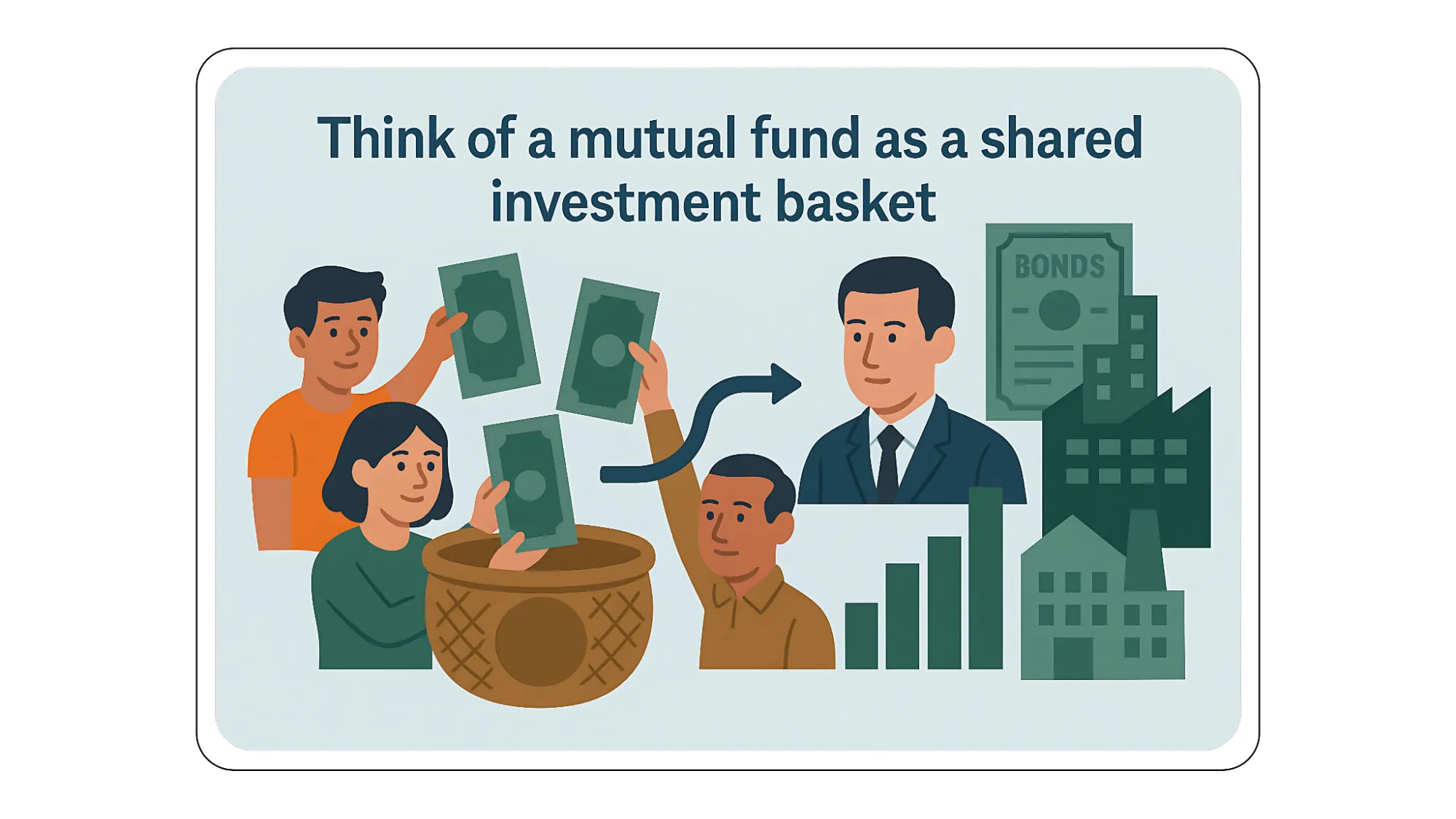
A better way to picture it:
Imagine taking a group cab ride. Instead of everyone driving separately (buying individual stocks), everyone pools their money for one ride. The professional driver (fund manager) takes the best route (investment strategy) to get everyone to the destination (financial growth). You don’t need to know the route or drive yourself; you just share the cost and benefit from the journey.

Key takeaway:
Mutual funds let you invest without needing to pick individual stocks or track the market daily. A professional handles the driving, and you share in the results.
Why do people use mutual funds?
Most people don’t have the time or interest to follow markets every day. Mutual funds offer a simple way to invest without the stress. They provide built-in diversification by spreading your money across many assets, reducing risk compared to buying a single stock. You can get started with a small amount, sometimes as little as ₹500, making it accessible to nearly everyone. Plus, your money is managed by experienced professionals who make investment decisions on your behalf, so you can focus on your life while they handle the details. Mutual funds provide a simplified investment option that balances risk and reward, making them ideal for long-term planning without constant effort or active management.
Real-life example
Imagine Praveen has ₹10,000 to invest. He has a few options: he could try picking a few stocks on his own, but that’s risky and can be confusing without experience. He could leave the money in a savings account—low risk, but extremely slow growth. Instead, Praveen chooses a mutual fund. His ₹10,000 is pooled together with money from thousands of other investors. A professional fund manager uses this larger amount to invest in a diversified mix of, say, 50 different companies. If many of those companies perform well, Praveen’s investment grows. And even if a few don’t, the gains from others can help offset the losses, reducing the risk compared to investing in a few stocks alone. Compared to letting his money sit idle in a savings account, this approach offers him greater exposure, professional guidance, and potential for higher returns.
What’s actually inside a mutual fund?
It depends!
Some funds focus on stocks (for growth), others on bonds (for stability), and some mix it up.
Here’s a quick cheat sheet:
| Fund Type | What’s Inside | Who It’s For |
|---|---|---|
| Equity Fund | Mostly stocks | Growth seekers |
| Debt Fund | Bonds, fixed income | Cautious investors |
| Hybrid Fund | Stocks + bonds | Want a bit of both |
| Index Fund | Mimics the market | Low-cost, hands-off folks |
How do you make money?
There are two main ways investors benefit from mutual funds:
Capital appreciation: When the value of the fund’s investments (like stocks or bonds) increases, the value of your investment grows too. This means your units become worth more over time.
Dividends or interest income: If the companies in the fund’s portfolio distribute dividends, or if the bonds pay interest, a portion of that income is shared with you, either as cash or reinvested into the fund, depending on the option you’ve chosen.
What about risks?
Let’s be honest—mutual funds are not risk-free.
Market fluctuations: The value of your investment can go up or down depending on market conditions. Like any market-linked investment, there's potential for losses.
No guarantees: Unlike a fixed deposit, mutual funds do not offer guaranteed returns.
However, because mutual funds invest in a diversified set of assets, the risk is generally spread out. A poor performance by one stock or bond typically has a limited impact on the overall portfolio. While there’s no guarantee of profit, regular monitoring by fund managers helps reduce the impact of market volatility on your investments.
Costs, commitments, and what to expect
Fees: Mutual fund managers charge a fee for managing your money—usually between 1% and 2% annually. This is called the expense ratio. In general, lower fees can mean better long-term returns.
Lock-in period: Most mutual funds allow you to withdraw your money anytime. However, certain types like ELSS (Equity Linked Savings Scheme) come with a lock-in period (typically three years) for tax benefits.
Returns: Returns are not guaranteed. While past performance can offer some insights, ongoing monitoring and smart fund selection can help improve long-term outcomes.
How to get started
Define your goal: Are you saving for a home, a vacation, your child’s education, or retirement? Knowing your objective helps in choosing the right fund.
Choose the right fund: Match your investment goal with your risk appetite. Equity funds for long-term growth, debt funds for stability, or balanced funds for a mix of both.
Start small: You don’t need a lump sum. Starting with just ₹500 a month through a SIP (Systematic Investment Plan) is enough to begin your journey.
Be consistent: Investing is about patience and discipline. Stay invested for the long term to ride out market ups and downs.
Take the first step: Visit Tradejini.com or download the CubePlus app to open your free Demat account and start investing in mutual funds today.
Example of a mutual fund dashboard: Parag Parikh Arbitrage Fund
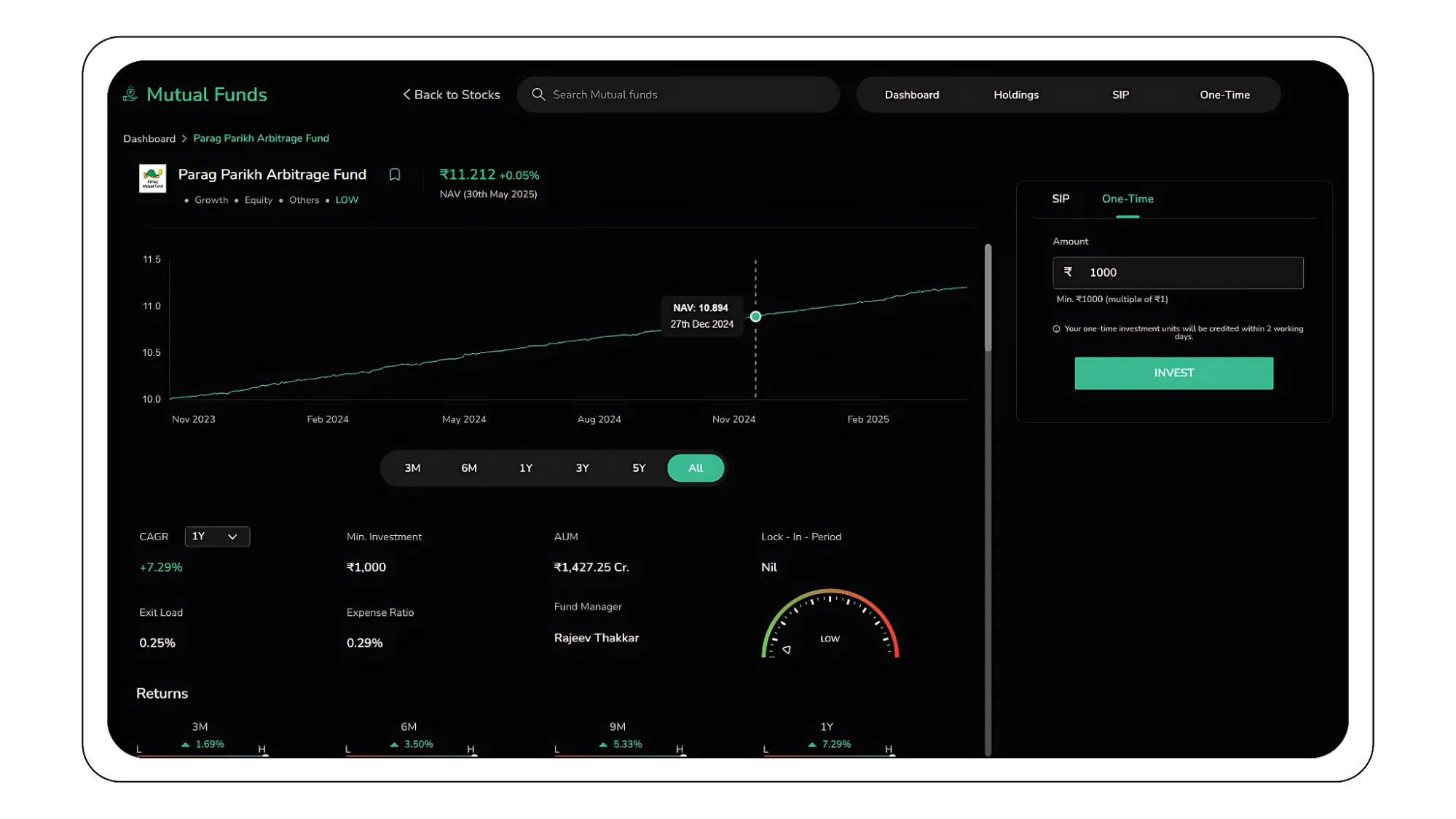
The image above displays the performance summary of the Parag Parikh Arbitrage Fund, a low-risk equity arbitrage mutual fund. This dashboard provides key details such as:
NAV (Net Asset Value): ₹11.212 as on 30th May 2025
1-Year CAGR: 7.29%
Fund Manager: Rajeev Thakkar
Expense Ratio: 0.29%
Exit Load: 0.25%
Assets Under Management (AUM): ₹1,427.25 Cr
Minimum Investment: ₹1,000
This interface on CubePlus also offers a performance chart, time period filters, and investment options (SIP or one-time). It's a practical example of how investors can monitor returns, make informed decisions, and invest directly through the platform.
A practical path to wealth
Mutual funds aren’t a shortcut to wealth, but they are one of the most practical, accessible, and professionally managed ways to grow your money. By pooling resources with other investors, you gain exposure to diversified investments and benefit from expert management, without needing to be a market expert yourself.
Think of it like a team sport: You bring your contribution, the fund manager (your coach) makes the strategy calls, and everyone shares in the outcome; whether it’s a win or a learning moment. And the best part? You don’t need to master every rule of the game.
Ready to begin?
Clarify your financial goal.
Choose a mutual fund that aligns with it.
Invest through Tradejini’s CubePlus app.
Start small—but start now.
As the saying goes, “The best time to plant a tree was 20 years ago. The second-best time is today.”
Disclaimer: The information provided in our blogs is for informational purposes only and should not be construed as financial, investment, or trading advice. Trading and investing in the securities market carries risk. Always conduct your own research and consult with a qualified financial advisor before making any investment decisions. Past performance is not indicative of future results. Copyrighted and original content for your trading and investing needs.
©️ 2025 — Tradejini. All Rights Reserved.