

Stock Market?
The Indian Stock Market is a network of exchanges and platforms where shares of publicly traded companies are bought and sold. These shares represent partial ownership in companies, and owning them allows investors to potentially benefit from the company's growth and profits.
Structure and Participants
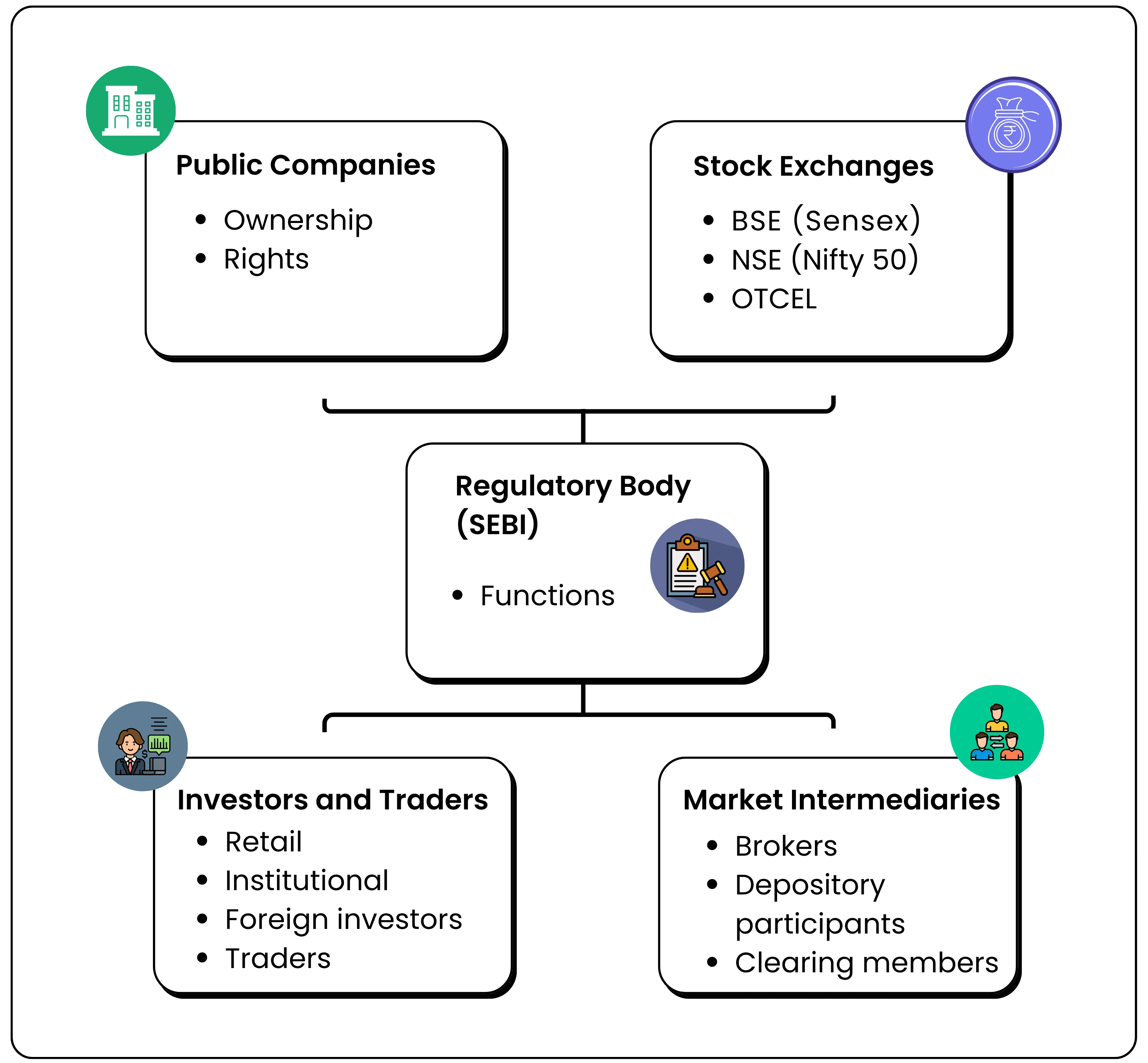
Public Companies
Indian businesses, from large conglomerates like Reliance Industries to emerging start-ups, list their shares on major stock exchanges to raise capital for operations, expansion, and R&D. These shares give investors a fractional ownership stake, voting rights, and potential dividends. The Indian Stock Market structure ensures these companies can efficiently access funds while maintaining transparency and investor confidence.
Stock Exchanges
- Bombay Stock Exchange (BSE): Founded in 1875, it is Asia’s oldest exchange, listing over 5,000 companies. Its flagship index is the BSE Sensex, which tracks 30 leading stocks.
- National Stock Exchange (NSE): Established in 1992, NSE revolutionized trading in India with electronic systems. The key benchmark, Nifty 50, tracks 50 major Indian companies.
- Other Platforms: The Over-The-Counter Exchange of India (OTCEL) is used for small and medium-sized companies.
When comparing BSE Sensex vs NSE Nifty 50, both serve as vital indicators of India’s economic and stock market performance.
Regulatory Body
The Securities and Exchange Board of India (SEBI) is the apex regulatory authority for the Indian securities market. Its core responsibilities include protecting investor interests, ensuring market transparency, and maintaining market integrity. The SEBI regulatory role is central to the functioning of the Indian Stock Market, as it regulates participants like brokers and merchant bankers, enforces rules to prevent fraudulent practices, and promotes fair trade. Through robust supervision and enforcement powers, SEBI fosters a secure, efficient, and trustworthy environment for capital market operations.
Investors and Traders
- Retail Investors: Individuals making their own investment decisions, typically buying smaller amounts of shares for personal portfolios.
- Institutional Investors: Organizations like mutual funds, pension funds, insurance companies, and banks that invest large sums and shape market direction.
- Foreign Portfolio Investors (FPIs): Overseas institutions investing in Indian securities, enhancing liquidity and providing global perspective.
- Traders: Individuals or organizations aiming for short-term profits through price fluctuations.
The Retail vs Institutional Investors dynamic significantly influences trading volumes, liquidity, and overall market sentiment within the Indian Stock Market structure.
Market Intermediaries
- Brokers: Agents through whom investors place orders. They provide market access, information, and execute trades.
- Depository Participants: Facilitate electronic storage and transfer of securities.
- Clearing Members/Houses: Responsible for settlement of trades, ensuring completion and transfer of securities and money.
Other Key Entities
- Merchant Bankers: Manage IPOs, public issues, mergers, and acquisitions.
- Registrar and Transfer Agents: Handle record keeping of share ownership and facilitate transfer processes.
- Analysts, Advisors: Provide investment research and portfolio advice to investors.
Also read: how Stock Market in India
How it works?
The Primary vs Secondary Market in India defines the two major segments of the Indian Stock Market structure.
The Primary Market also known as the new issue market, this is where new securities are created and sold for the first time. It allows companies, governments, and other entities to raise fresh capital directly from investors. This process helps in financing business expansion, infrastructure projects, and debt repayment.
A Secondary Market is a financial marketplace where investors buy and sell existing securities, such as stocks, bonds, and other financial instruments. These are securities that have already been issued in the primary market, typically through an Initial Public Offering (IPO). In the secondary market, the issuing company is not directly involved in the trades, and the proceeds go to the selling investor rather than the company.
Instruments and Innovations
The Indian Stock Market offers a diverse range of financial instruments in India and innovative technologies, enhancing investment opportunities and accessibility:
Equities: Represent ownership in companies through shares, allowing investors to benefit from capital appreciation and dividends.
Derivatives: Financial contracts like futures, options, forwards, and swaps, deriving value from underlying assets; used extensively for hedging risks and speculative trading on stocks, indices, commodities, and currencies.
ETFs, REITs, and Sovereign Gold Bonds:
- Exchange-Traded Funds (ETFs) provide diversified investment in baskets of assets.
- Real Estate Investment Trusts (REITs) give exposure to real estate without direct ownership.
- Sovereign Gold Bonds offer a gold-backed investment alternative with periodic interest.
Technology: Advanced electronic trading platforms, mobile apps, and UPI-based payment systems have democratized stock market participation, enabling millions of retail investors to trade seamlessly and securely.
How Stock Prices Are Determined
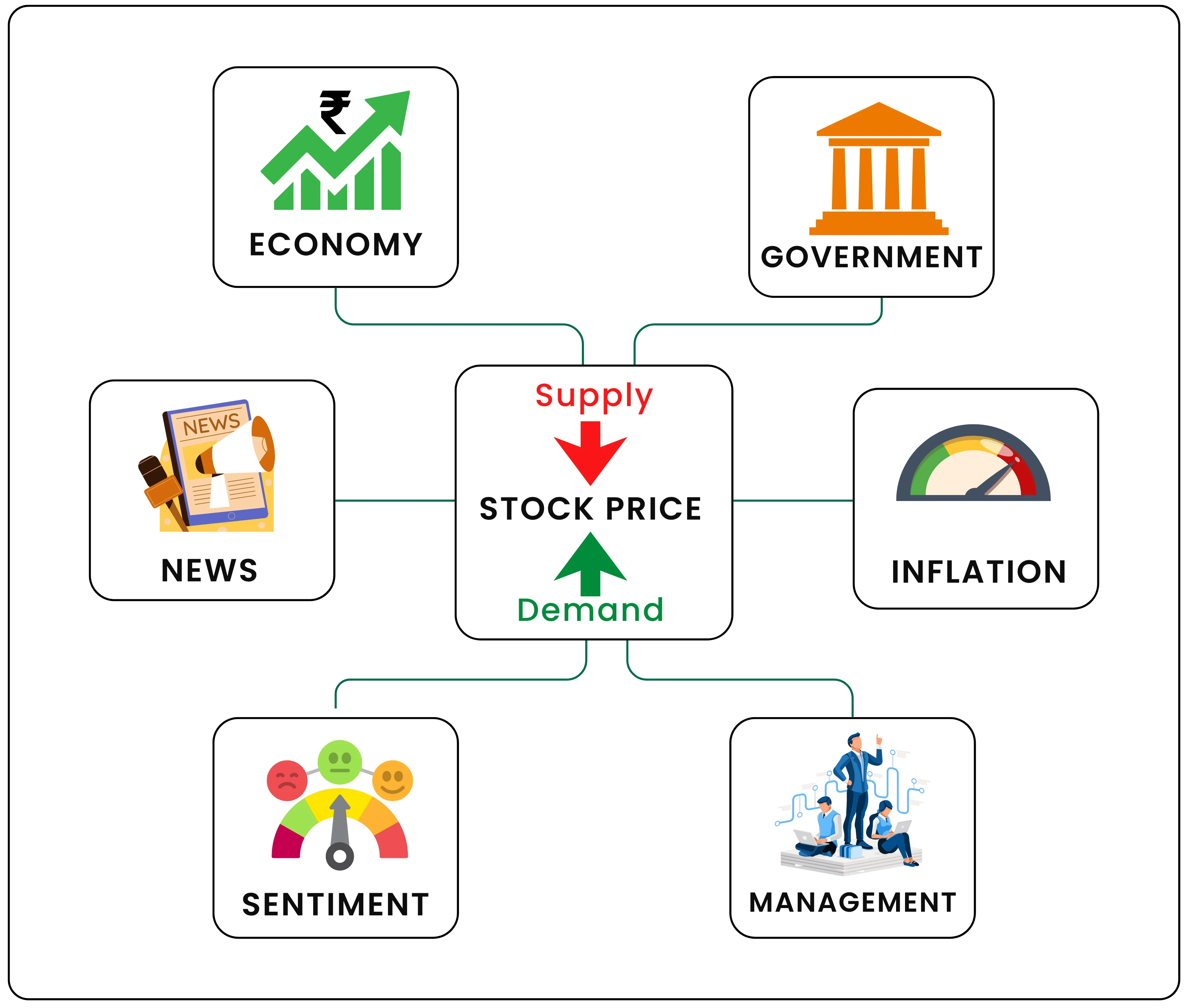
Stock Price determination factors in the Indian Stock Market move based on several interrelated components:
Supply and Demand: Stock prices fundamentally reflect the balance between buyers and sellers. When demand exceeds supply, prices increase; when supply surpasses demand, prices drop. This real-time negotiation shapes price discovery on trading platforms.
Business Performance: Over the long term, stock prices are anchored by company fundamentals, earnings growth, profitability, competitive position, and future prospects. Strong financial results and positive forecasts tend to drive up valuations.
Market Sentiment: Short-term price movements often react to news, economic data, government policies, and investor psychology. Positive developments like government reforms or sector growth can boost prices, while adverse events, political instability, or economic uncertainty can trigger volatility.
External Factors: Macroeconomic indicators such as interest rates set by the Reserve Bank of India, inflation levels, global geopolitical events, and black swan events (e.g., pandemics or financial crises) can profoundly affect stock prices, amplifying market swings beyond company-specific factors.
Technical Factors: Trading volumes, historical price trends, and market momentum also influence price dynamics, with many traders using these indicators to forecast short-term movements and make strategic decisions.
Also read: What moves a stock price
Indices
Indices are essential tools that track and represent the collective performance of groups of stocks, providing a clear benchmark for market trends and sector movements within the Indian Stock Market structure.
Stock market indices group stocks with similar traits or origins. Major indices include broad-based benchmarks and sectoral indices. Broad-based indices like Nifty 50 and BSE Sensex aggregate leading companies across various sectors to reflect the overall market mood. Sectoral indices focus on specific industries, tracking the performance of key sectors such as banking, IT, pharma, FMCG, and more.
Major Indian Equity Indices
NSE Nifty 50:
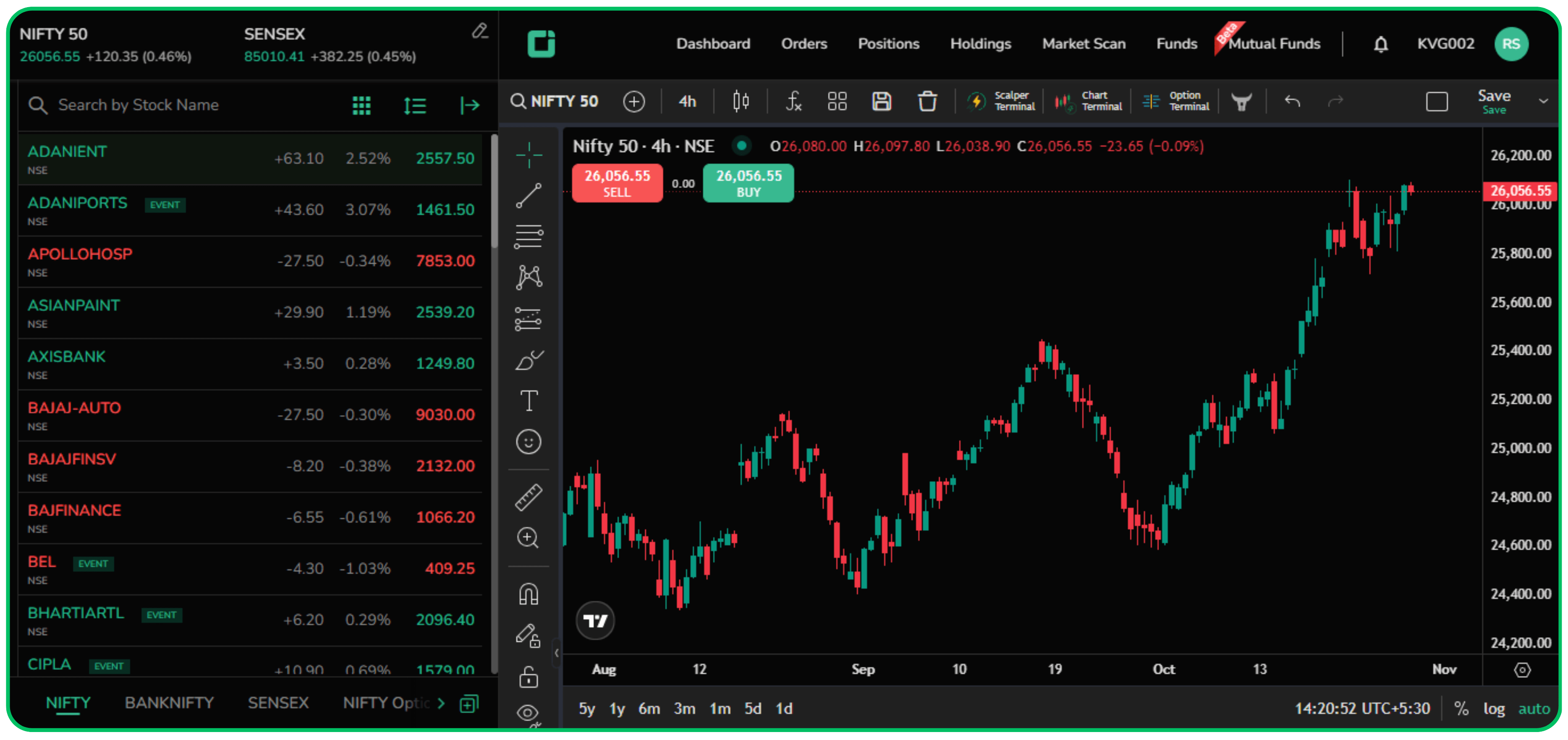
Tracks the 50 largest and most liquid stocks listed on the National Stock Exchange (NSE). Nifty 50 is India's core broad market benchmark covering sectors like financial services, IT, consumer goods, auto, energy, and more. As of October 2025, the Nifty 50 reflects approximately 55% of NSE's free-float market capitalization.
BSE Sensex:
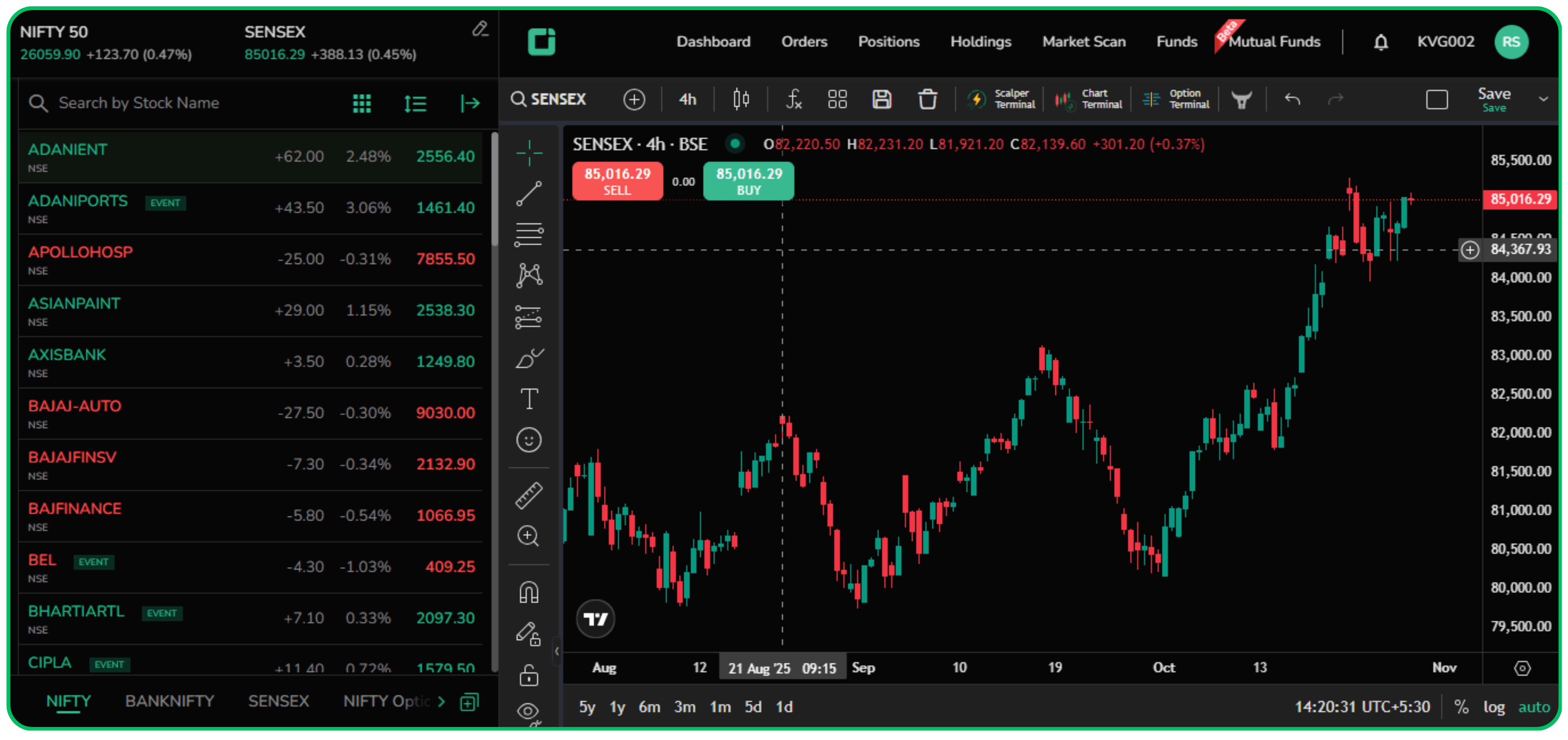
It comprises 30 highly reputed companies from diverse sectors listed on the Bombay Stock Exchange (BSE). India's oldest and most observed index, the Sensex serves as an economic barometer and is used for long-term trend analysis.
Nifty Bank:
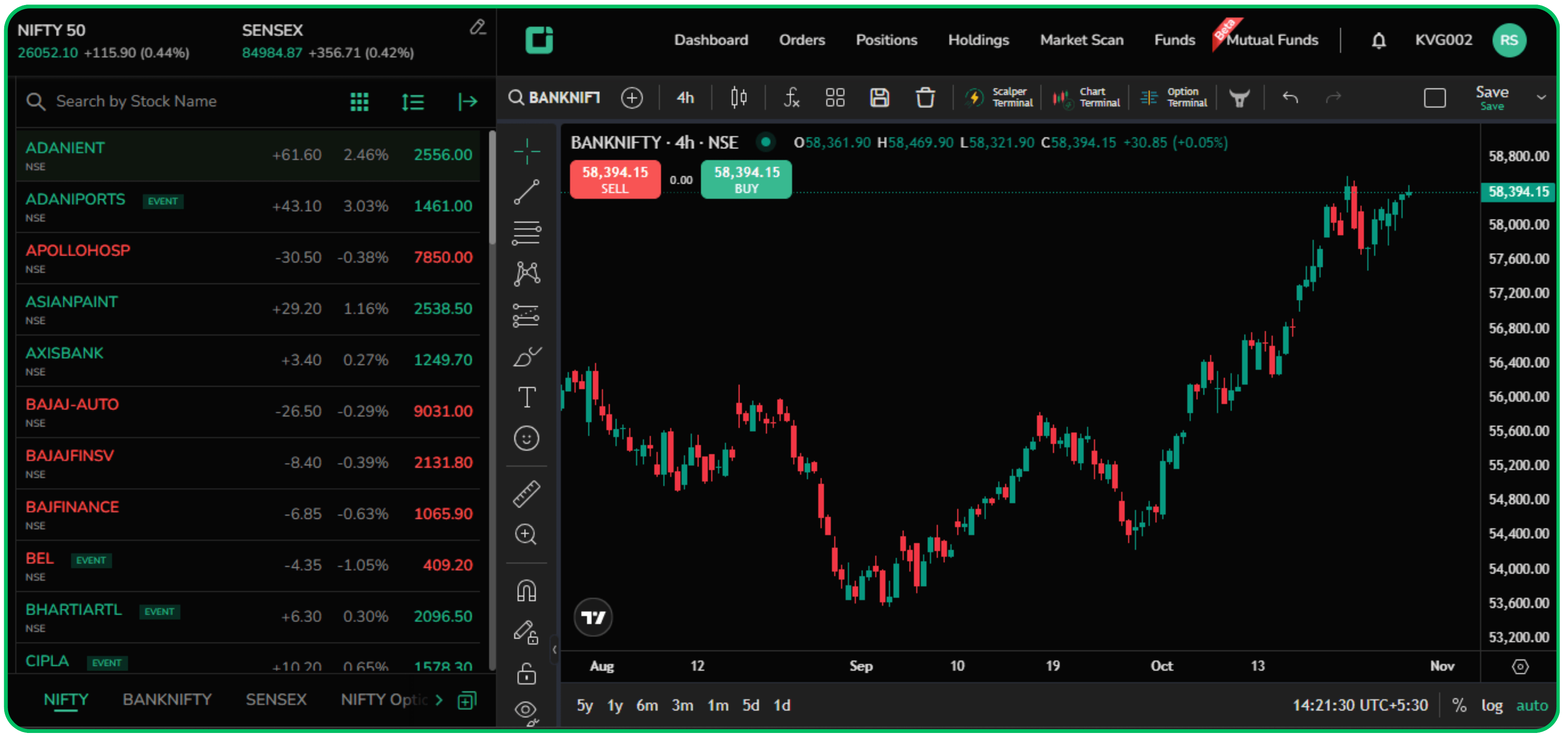
Measures performance of the largest, most liquid banking stocks on the NSE, covering both private and public sector banks. The Nifty Bank is synonymous with "Bank Nifty" and is often referenced in derivative, trading and sector analysis.
Nifty Financial Services:
Benchmarks top financial institutions, including banks, NBFCs, insurance companies, and financial advisors listed on the NSE. The "Fin Nifty" 25/50 variant ensures diversified representation within the index.
Looking Forward
The Indian Stock Market stands as the dynamic heartbeat of the nation’s economy, connecting businesses in need of capital with investors seeking growth opportunities. From the pillars of the BSE and NSE to the vigilant oversight of SEBI, the market operates as a transparent, technology-driven ecosystem that empowers participation across every level from seasoned institutions to first-time retail investors.
Understanding how the market works, what stock price determination factors drive prices, and the roles of its key participants enables investors to make informed, strategic decisions. As India continues to expand economically and digitally, the Indian Stock Market not only mirrors that growth but also serves as a powerful vehicle for wealth creation and national progress.
Disclaimer: The information provided in our blogs is for informational purposes only and should not be construed as financial, investment, or trading advice. Trading and investing in the securities market carries risk. Always conduct your own research and consult with a qualified financial advisor before making any investment decisions. Past performance is not indicative of future results. Copyrighted and original content for your trading and investing needs.
© 2025 — Tradejini. All Rights Reserved.
.webp%3Falt%3Dmedia%26token%3D0ead9799-20bc-4d1e-ae8f-d75ab18921b5&w=3840&q=75)