







An Iron Fly is a short straddle with the tails covered. A trader sells an at-the-money call and an at-the-money put on the same underlying and the same expiry, then buys a call and a put further out, at roughly the distance where the position's breakeven sits, to cap the risk on both sides. The result is a defined-risk, delta-neutral structure built to profit from a fall in implied volatility rather than from a move in the stock. This is a short-vega trade, not a directional one.
When Does This Trade Make Sense
The Iron Fly is not a structure to run at all times. It is built for a specific window: after an event or a bout of market stress has pushed implied volatility sharply higher. Before considering the trade, IV Percentile (IVP) and IV Rank (IVR) should both read above 80. At that level, options are priced for a continuation of the volatility spike that has already occurred, and the premium available on the short strikes reflects that elevated pricing.
Reading the Entry Signal
Elevated IV on its own is the precondition, not the trigger. The entry comes once the stock has moved back to a support level and shows momentum or volatility divergence, an indication that the move behind the IV spike is losing force. Alongside this, IVP and IVR should start cooling off from their peak rather than continuing to climb. Two further reads confirm the picture: implied volatility falling below the 10-day historical volatility, and the gap between implied volatility and realized volatility narrowing. Taken together, these suggest the volatility expansion has peaked and is reverting, which is the environment a short-vega structure like the Iron Fly is designed for.
Building the Iron Fly on NxtOption
On NxtOption's Strategy Builder, the structure is listed under the Neutral tab as Iron Butterfly, alongside other neutral strategies such as Short Straddle, Short Strangle, and Short Iron Condor. Selecting it lays out four legs on the same expiry: a long put, a short put, a short call, and a long call.
A representative payoff built on the platform illustrates the structure. With Infosys (INFY) at 1,072.10 and expiry set to 28 July 2026, the position was built as follows.
| Leg | Action | Type | Strike | Expiry | Entry Price |
|---|---|---|---|---|---|
| 1 | Buy | Put | 1,020 | 28 Jul 2026 | 13.60 |
| 2 | Sell | Put | 1,070 | 28 Jul 2026 | 33.45 |
| 3 | Sell | Call | 1,070 | 28 Jul 2026 | 28.40 |
| 4 | Buy | Call | 1,120 | 28 Jul 2026 | 11.10 |
NxtOption's payoff panel summarized the position as follows.
| Metric | Value |
|---|---|
| Net premium received | 37.15 |
| Maximum profit | 14,860.00 (29.66% of margin) |
| Maximum loss | 5,140.00 (10.26% of margin) |
| Probability of profit | 36.97% |
| Lower breakeven | 1,032.86 (3.66% below spot) |
| Upper breakeven | 1,107.16 (3.27% above spot) |
| Risk to reward ratio | 0.35 |
| Margin required | 50,102.80 |
| Margin available (this instance) | 9,060.00 |
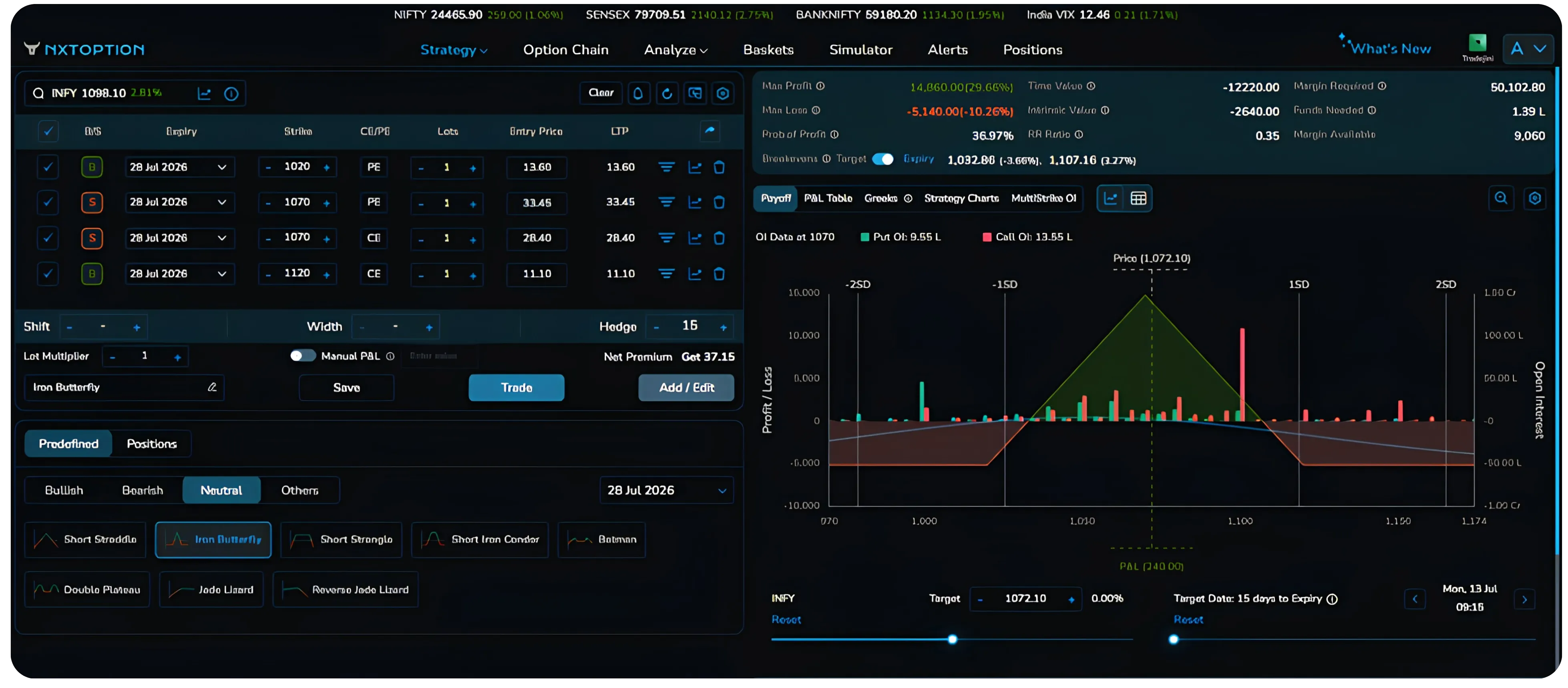
This example is shown only to illustrate how the legs and payoff appear on Strategy Builder. It is not a comment on whether Infosys met the IV or entry conditions described above at the time.
Also Read: OI Change on NXTOption — What It Tells Traders
Screening for Candidates
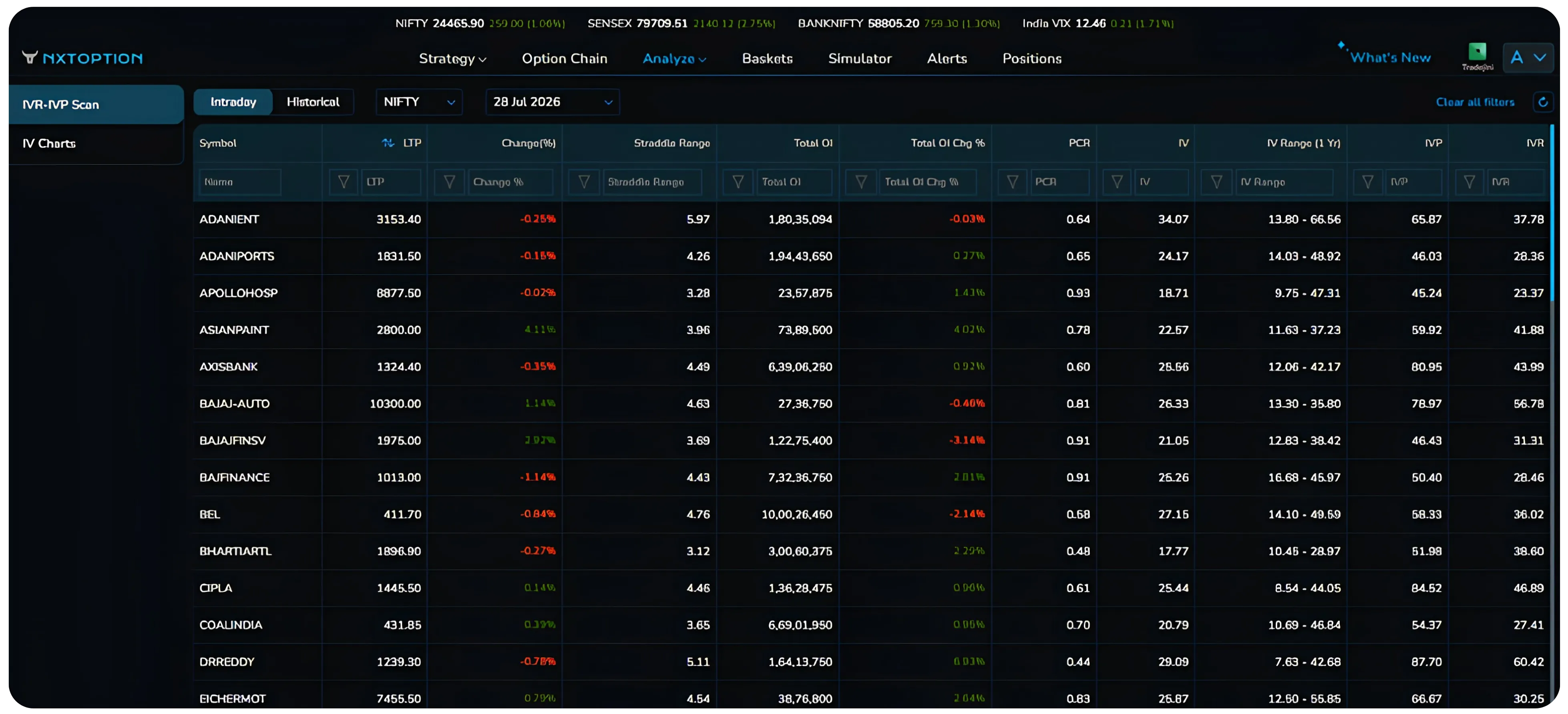
The stocks worth watching for this setup are filtered on NxtOption's IVR-IVP Scan page, under Analyze. The scanner lists IV, the one-year IV range, IVP, and IVR for each stock side by side, making it possible to filter directly for names where IVP and IVR sit above 80, the starting condition for this trade.
Tracking the Cooling-Off
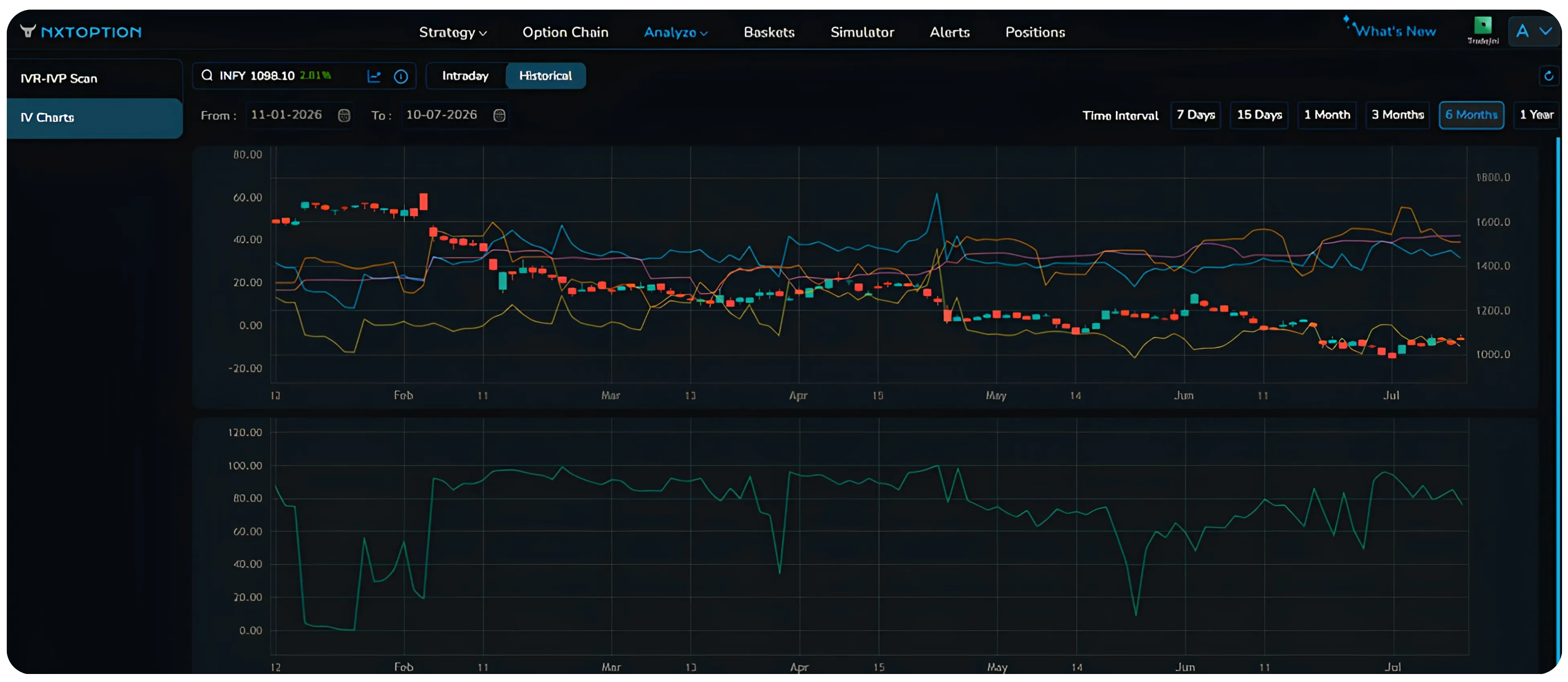
Once a candidate is shortlisted, the cooling-off itself is tracked on NxtOption's IV Charts page. It plots implied volatility against the 10-day historical volatility and the underlying price over time, making it possible to watch the gap between implied and realized volatility narrow as the post-event spike fades. This is the same read described under the entry signal, applied over time instead of at a single snapshot.
Exit Rules
Three separate triggers apply, and any one of them is sufficient to close the position.
The first is profit-based. Book the trade once 50% of the maximum profit has been realized.
The second is volatility-based. Exit once IVP and IVR normalize, that is, once they fall back from the elevated zone that justified the entry. At that point, the volatility contraction the trade was built around has already played out.
The third is time-based. If neither of the first two triggers is hit, close the position within one or two sessions of entry. This is a short-duration trade built around a specific volatility event, not a multi-week hold.
Disclaimer: The information provided in our blogs is for informational purposes only and should not be construed as financial, investment, or trading advice. Trading and investing in the securities market carries risk. Always conduct your own research and consult with a qualified financial advisor before making any investment decisions. Past performance is not indicative of future results. Copyrighted and original content for your trading and investing needs.
© 2026 — Tradejini. All Rights Reserved.